
How Does an MPPT Controller Optimize Efficiency, Stability, and System Flexibility in Photovoltaic Systems?
Introduction
As photovoltaic systems continue to evolve toward higher efficiency and smarter energy management, the role of the MPPT controller has become increasingly central rather than optional. Modern solar power systems are no longer static setups that operate under fixed conditions. Instead, they must adapt continuously to fluctuating sunlight, changing temperatures, and varying load demands. Under these dynamic conditions, simply connecting solar panels to batteries or inverters without intelligent regulation often leads to significant energy losses.
An MPPT controller acts as the intelligent link between solar panels and the rest of the photovoltaic system. Its core purpose is to ensure that solar modules operate at their optimal power point at any given moment, regardless of external conditions. Without this function, a photovoltaic system may still generate power, but it rarely operates at its full potential. Over time, this inefficiency translates into reduced energy yield, slower battery charging, and less predictable system performance.

Another important shift lies in how photovoltaic systems are designed today. Earlier systems were often built with narrow operating margins and limited flexibility. In contrast, modern installations prioritize adaptability, long-term reliability, and efficient energy utilization across a wide range of operating scenarios. The MPPT controller plays a key role in supporting this transition by enabling more flexible system configurations, wider voltage ranges, and improved compatibility between solar panels, batteries, and downstream power electronics.
Understanding how an MPPT controller functions within a photovoltaic system is therefore essential for anyone involved in system design, integration, or performance optimization. Rather than being a simple accessory, it directly influences how much energy is captured, how reliably the system operates, and how well it can adapt to real-world solar conditions. This makes the MPPT controller a foundational component in achieving efficient and stable photovoltaic power generation.
What Is an MPPT Controller and Why Is It Essential in Modern Photovoltaic Systems?
An MPPT controller (Maximum Power Point Tracking controller) is a specialized power electronics device designed to optimize the energy transfer between solar panels and the rest of a photovoltaic system. Unlike basic charge controllers, it continuously analyzes the electrical characteristics of the solar array and adjusts its operating point to extract the maximum available power at any given moment. This capability makes it a core functional component rather than an optional upgrade in modern photovoltaic system design.
Understanding the Maximum Power Point Concept
Every solar panel has a specific voltage–current combination at which it produces the highest possible power output. This point is not fixed. It shifts throughout the day as sunlight intensity, panel temperature, and environmental conditions change. Without intelligent tracking, a photovoltaic system often operates away from this optimal point, leaving a portion of potential energy unused.
The MPPT controller dynamically tracks this optimal operating point and converts the panel output to match system requirements, ensuring that available solar energy is utilized as efficiently as possible.
Bridging the Gap Between Solar Modules and System Loads
In a photovoltaic system, solar panels, batteries, and inverters rarely share the same voltage characteristics. Directly coupling these components can result in mismatches that reduce efficiency or limit system flexibility. An MPPT controller acts as an adaptive interface, allowing higher-voltage solar arrays to work efficiently with lower-voltage battery banks or DC buses.
This voltage conversion capability enables more flexible system layouts, longer cable runs, and better use of available panel configurations without sacrificing performance.
Supporting System Stability and Predictable Operation
Beyond energy optimization, an MPPT controller contributes to overall system stability. By regulating charging behavior and controlling power flow, it helps maintain consistent operating conditions for downstream components. This reduces electrical stress on batteries and connected equipment, supporting longer service life and more predictable system behavior over time.
In systems where reliability and continuity are critical, this controlled and adaptive power management becomes a defining advantage.
Why MPPT Controllers Are Now a Standard Choice
As photovoltaic systems scale in capacity and complexity, the limitations of simpler control methods become more apparent. Modern systems demand higher efficiency, broader operating ranges, and the ability to adapt to diverse installation conditions. The MPPT controller addresses these needs directly, which is why it has become a standard design choice in contemporary photovoltaic solutions rather than a niche option.
How Does an MPPT Controller Improve Energy Harvesting Efficiency Under Changing Solar Conditions?
Solar energy production is inherently variable. Sunlight intensity shifts throughout the day, panel temperature rises and falls with environmental conditions, and partial shading can occur unexpectedly. Under these constantly changing factors, a photovoltaic system that operates at a fixed voltage or current point will rarely achieve optimal performance. This is where the MPPT controller demonstrates its most significant value—by continuously maximizing energy harvesting efficiency in real time.
Adapting to Fluctuating Irradiance Levels
Solar irradiance can change rapidly due to cloud movement, seasonal variation, or installation orientation. Each change alters the electrical behavior of the solar modules. An MPPT controller continuously monitors panel output and adjusts the operating point to match the new conditions.
Instead of allowing power output to drop when sunlight weakens, the controller recalculates and tracks the most efficient voltage–current combination, ensuring that available solar energy is converted into usable power as effectively as possible.
Managing Temperature-Related Performance Shifts
Temperature has a direct impact on solar panel voltage. As panel temperature increases, voltage typically decreases, which can significantly affect overall power output. Without intelligent regulation, this mismatch can lead to persistent efficiency losses during high-temperature operation.
An MPPT controller compensates for these temperature-induced shifts by dynamically adjusting its tracking behavior. This allows the photovoltaic system to maintain higher efficiency even during prolonged periods of heat exposure, supporting more consistent energy generation across daily operating cycles.
Responding to Partial Shading and Uneven Conditions
In real-world installations, partial shading from nearby structures, dust accumulation, or uneven panel exposure is often unavoidable. These conditions can distort the power curve of a solar array and reduce output if not managed correctly.
Advanced MPPT tracking logic helps identify the most productive operating region despite uneven conditions. By continuously scanning for the true maximum power point, the controller reduces the negative impact of shading and prevents the system from locking into inefficient operating states.
Converting Extra Energy Into Practical System Gains
The efficiency improvements delivered by an MPPT controller are not theoretical. Higher energy capture directly translates into faster battery charging, improved system autonomy, and more stable power availability for connected loads. Over time, these gains accumulate, improving the overall performance and reliability of the photovoltaic system without requiring additional solar modules.
How Does an MPPT Controller Support Stable and Scalable Photovoltaic System Design?
As photovoltaic systems grow beyond simple standalone setups, system stability and scalability become just as important as raw energy efficiency. An MPPT controller plays a key role in shaping how a photovoltaic system is structured, expanded, and maintained over its operational lifetime. By actively managing voltage, current, and power flow, it creates a more predictable and adaptable system foundation.
Enabling Flexible System Architecture
Photovoltaic systems are often constrained by mismatches between solar panel output and battery or DC bus requirements. An MPPT controller reduces these constraints by allowing solar arrays to operate at higher voltages while delivering regulated power to lower-voltage storage or distribution systems.
This flexibility simplifies array design, supports longer cable distances with lower losses, and allows system designers to choose panel configurations based on available space rather than rigid electrical limitations.
Supporting System Expansion Without Major Redesign
Scalability is a critical consideration in modern photovoltaic systems. As energy demand increases, additional panels or storage capacity may need to be added over time. MPPT controllers support this growth by accommodating wider input voltage ranges and variable power levels.
This capability makes it possible to expand system capacity incrementally without replacing core control components, reducing downtime and preserving system consistency as the installation evolves.
Maintaining Stable Charging and Power Flow
System stability depends on controlled energy transfer. Sudden voltage fluctuations or uncontrolled charging behavior can stress batteries and downstream equipment. An MPPT controller regulates charging profiles and power delivery, smoothing out variations caused by environmental changes or load shifts.
By maintaining steady operating conditions, it helps protect critical components and contributes to a more reliable and predictable photovoltaic system.
Reducing Long-Term Operational Stress
Electrical stress accumulates silently over time. Inefficient power conversion, unstable voltage levels, and excessive heat generation can shorten component lifespan. By operating panels at optimal points and regulating power flow efficiently, an MPPT controller minimizes unnecessary losses and thermal stress.
This results in a system that not only performs better day to day but also maintains its performance over longer service intervals with fewer maintenance demands.
In Which Photovoltaic Applications Does an MPPT Controller Deliver the Most Value?
The benefits of an MPPT controller become most evident when photovoltaic systems are deployed in real-world environments rather than ideal laboratory conditions. Variations in installation scale, operating conditions, and power demand all influence how much value intelligent power tracking can deliver. In many photovoltaic applications, the MPPT controller is a key factor in achieving consistent performance and long-term system reliability.
Off-Grid and Hybrid Power Systems
In off-grid and hybrid photovoltaic systems, energy availability must be carefully managed to ensure continuous operation. These systems often rely on batteries as the primary energy buffer, making efficient charging essential.
An MPPT controller maximizes solar energy capture throughout the day, enabling faster and more complete battery charging even under fluctuating sunlight. This directly improves system autonomy, reduces reliance on backup sources, and supports more stable power availability for connected loads.
Large-Scale and Distributed Solar Installations
As photovoltaic systems increase in size or become distributed across multiple arrays, maintaining uniform performance becomes more challenging. Differences in panel orientation, shading, or environmental exposure can create uneven power output.
MPPT controllers help mitigate these issues by dynamically optimizing power extraction from each array or input channel. This ensures that the system operates closer to its theoretical maximum efficiency, even when conditions vary across the installation.
Systems Operating in Harsh or Variable Environments
Photovoltaic systems are often deployed in environments with high temperatures, dust, or rapidly changing weather conditions. These factors can significantly affect panel voltage and overall system behavior.
An MPPT controller adapts continuously to these variations, maintaining stable energy conversion and preventing efficiency losses that would otherwise accumulate under challenging conditions. This adaptability is particularly valuable in installations where manual adjustment or frequent maintenance is impractical.
Applications Requiring Long-Term Performance Consistency
In applications where photovoltaic systems are expected to operate reliably over long periods, consistency matters as much as peak output. Small efficiency losses repeated daily can add up to substantial performance degradation over time.
By ensuring optimal operating conditions and reducing electrical stress on system components, an MPPT controller helps preserve system efficiency and reliability throughout its service life, making it a critical component in applications focused on durability and predictable operation.
What Should Be Considered When Selecting an MPPT Controller for a Photovoltaic System?
Selecting the right MPPT controller is not only about matching power ratings—it directly affects how efficiently, reliably, and flexibly a photovoltaic system will operate over time. A well-chosen controller ensures that system performance remains stable under real-world conditions and supports future expansion without unnecessary redesign.

Input Voltage Range and Array Compatibility
One of the first considerations is the controller’s allowable input voltage range. Solar arrays often operate at higher voltages than batteries or DC buses, especially in larger or space-constrained installations.
An MPPT controller with a wide input voltage range provides greater flexibility in panel configuration, allowing series connections that reduce current, minimize cable losses, and simplify wiring without compromising safety or efficiency.
Battery Type and Charging Logic
Photovoltaic systems frequently rely on energy storage to ensure stable power availability. Different battery technologies require distinct charging profiles and protection logic.
An MPPT controller should support the intended battery type and manage charging stages accurately. Proper charging control helps prevent overcharging or underutilization, contributing to longer battery life and more predictable system behavior.
System Power Scale and Expansion Potential
Photovoltaic systems rarely remain static. Load growth, additional panels, or expanded storage capacity are common over time. Choosing an MPPT solar charge controller with sufficient power margin and scalability helps accommodate these changes smoothly.
This forward-looking approach avoids early system bottlenecks and reduces the need for component replacement as system requirements evolve.
Thermal Management and Long-Term Reliability
Efficient power conversion reduces heat generation, but thermal performance remains a key factor in controller longevity. An MPPT controller designed for continuous operation under variable loads and temperatures contributes to stable system performance over extended service periods.
Reliable thermal management not only protects the controller itself but also reduces stress on surrounding system components.
Conclusion
Within a modern photovoltaic system, the MPPT controller serves as the intelligent core that connects energy generation, storage, and utilization. By continuously optimizing power extraction, stabilizing system operation, and enabling flexible system design, it plays a decisive role in overall performance and long-term reliability.
Whether the goal is higher energy yield, improved system stability, or scalable system architecture, selecting the right MPPT controller is a foundational step toward efficient photovoltaic power generation.
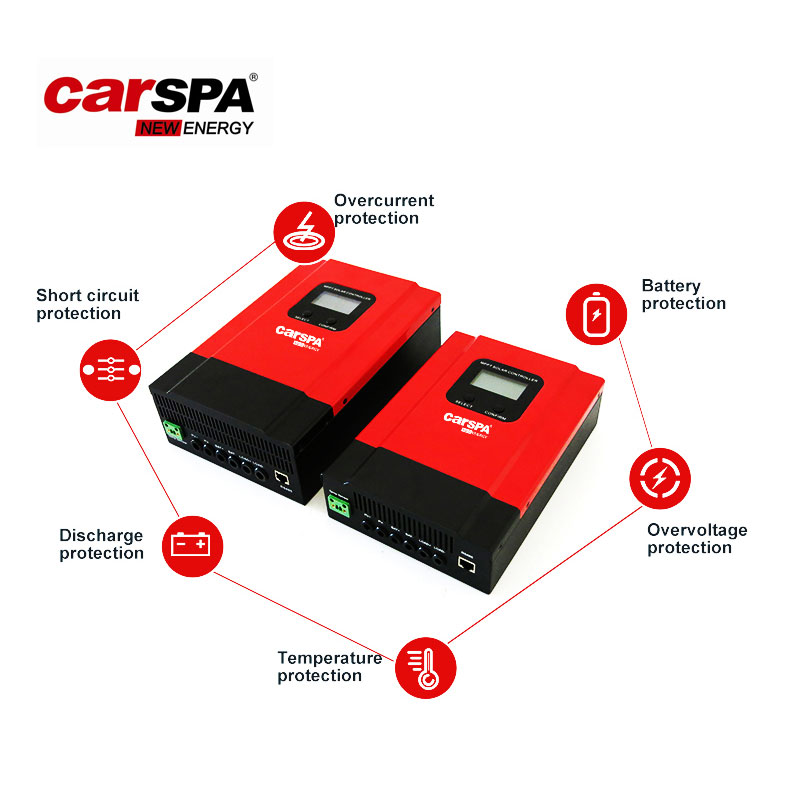
Solutions developed by CARSPA reflect this system-oriented approach, offering MPPT controllers designed to support efficient energy conversion, stable operation, and adaptable photovoltaic system integration over the long term.


