How Is Home Energy Storage Used in Solar-Integrated Power Systems?
Introduction
As solar power becomes an increasingly common energy source, power systems are no longer designed around generation alone. In real-world operation, the key challenge is not how much energy can be produced, but when and how that energy is available for use. Solar output fluctuates throughout the day, while electricity demand often peaks outside of optimal generation hours. This mismatch makes energy storage a critical component in modern solar-integrated power systems.
Home Energy Storage addresses this challenge by acting as a bridge between energy production and energy consumption. Rather than relying solely on real-time solar generation, storage systems capture excess energy during high-production periods and release it when power is needed most. This enables more consistent power availability, improves overall system efficiency, and reduces dependence on external power sources.
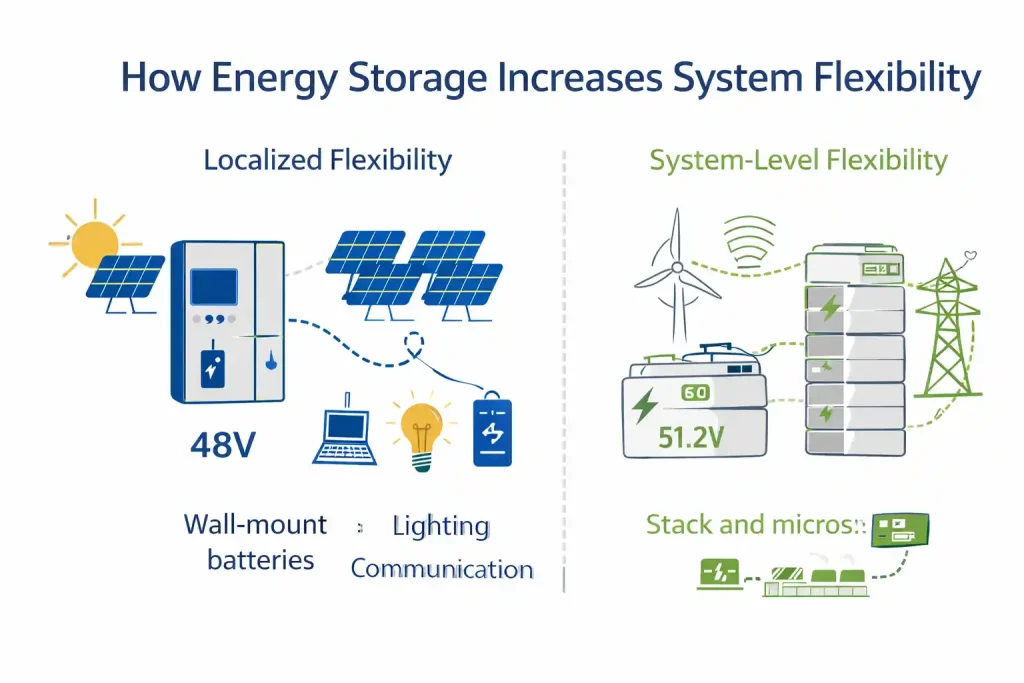
In solar-integrated applications, energy storage is not limited to backup use. It plays an active role in daily power management, load balancing, and system stabilization. Wall-mounted and stackable storage configurations further enhance flexibility, allowing systems to be tailored to different installation conditions and energy demand levels. When combined with long-cycle-life lithium battery technology, home energy storage becomes a reliable foundation for continuous daily operation rather than an occasional support component.
This article focuses on how Home Energy Storage is applied within solar-integrated power supply systems, examining its role in daily operation, load support, system scalability, and long-term performance. By understanding how storage functions within this specific scenario, it becomes easier to evaluate system design choices and optimize energy utilization over time.
Why Is Home Energy Storage Essential in Solar-Integrated Power Systems?
In solar-integrated power systems, energy generation and energy usage rarely occur at the same time. Solar panels typically deliver peak output during daylight hours, while actual electricity demand often extends into the evening or occurs intermittently throughout the day. Without energy storage, this imbalance leads to wasted generation potential and unstable power availability.
Bridging the Gap Between Energy Production and Consumption
One of the primary roles of Home Energy Storage is to resolve the timing mismatch between solar generation and real-world energy demand. During periods of strong solar output, excess energy can be stored rather than curtailed. This stored energy is then released when generation drops, ensuring that power remains available even when solar input is limited or unavailable.
By decoupling energy use from real-time generation, storage systems allow solar power to become a controllable resource instead of a variable one. This significantly improves the usability of solar energy in daily operation.
Improving Power Stability in Variable Solar Conditions
Solar output is inherently affected by weather, seasonal changes, and shading conditions. These fluctuations can cause voltage instability or inconsistent power delivery if the system relies solely on generation. Home Energy Storage absorbs these variations by acting as a buffer within the power system.
When solar production drops suddenly, stored energy compensates for the shortfall. When production exceeds immediate demand, storage absorbs the surplus. This stabilizing effect helps maintain consistent power quality and protects connected loads from sudden power changes.
Enabling Continuous Operation Beyond Daylight Hours
Without storage, solar systems are effectively limited to daytime use. Energy storage extends system functionality into nighttime and low-generation periods, enabling continuous operation across a full daily cycle. This is particularly important for environments where power availability is expected to remain stable regardless of solar conditions.
By providing a reliable energy reserve, Home Energy Storage transforms solar systems from partial contributors into primary power sources capable of supporting daily energy needs over extended periods.
Supporting Smarter System Design and Energy Utilization
Integrating energy storage at the system level allows for more intelligent power management strategies. Instead of oversizing solar arrays to compensate for variability, designers can balance generation capacity with appropriately scaled storage. This results in more efficient system layouts, improved energy utilization, and greater operational predictability.
In this context, Home Energy Storage is not an optional add-on—it is a core element that determines how effectively solar energy can be captured, managed, and used within modern power systems.

How Does Home Energy Storage Work with Solar Panels in Daily Operation?
In a solar-integrated power system, Home Energy Storage operates as an active energy manager rather than a passive backup component. Its primary function is to coordinate energy flow between solar panels, connected loads, and stored capacity across different operating conditions throughout the day.
Daytime Energy Flow: Powering Loads and Charging Storage
During daylight hours, solar panels typically serve as the primary energy source. Electricity generated by the panels is first supplied directly to active loads, reducing the need for stored or external power. When generation exceeds immediate demand, the surplus energy is directed to the storage system for charging.
This charging process allows the system to capture energy that would otherwise be unused, preparing it for later consumption. Home Energy Storage effectively transforms variable solar output into a usable energy reserve, smoothing out short-term fluctuations in generation.
Transition Periods: Managing Partial Generation and Load Demand
In real operation, solar output rarely aligns perfectly with load demand. During morning and late afternoon hours, generation may only partially cover consumption. In these situations, Home Energy Storage supplements solar power by discharging stored energy as needed.
This hybrid supply mode ensures that power delivery remains stable even when solar production is insufficient. Instead of abrupt source switching, the system maintains continuous operation by dynamically balancing generation and storage output.
Nighttime Operation: Supplying Power Without Solar Input
Once solar generation stops, Home Energy Storage becomes the primary power source within the system. Stored energy is released to support connected loads until the next charging cycle begins. This enables uninterrupted operation across night hours and low-generation periods.
For systems designed for daily cycling, this discharge phase is not an exception but a routine part of operation. Reliable storage performance during nighttime use is essential for maintaining consistent power availability.
External Battery Support and System Flexibility
Many storage systems are designed to support external battery connections, allowing capacity to be adjusted based on actual energy demand. This flexibility enables system operators to expand storage capacity without redesigning the entire power architecture.
By supporting modular expansion, Home Energy Storage systems can adapt to changing energy usage patterns, making them suitable for long-term operation in solar-integrated environments.
What Types of Power Loads Can Home Energy Storage Support in This Scenario?
In a solar-integrated power system, the value of Home Energy Storage is ultimately measured by how effectively it supports real operating loads. Unlike backup-only systems designed for occasional use, daily-cycling energy storage must handle a mix of load types with different power characteristics and stability requirements.
Supporting Continuous and Essential Loads
Home Energy Storage is particularly effective at supplying continuous loads that require stable, uninterrupted power. These loads typically operate for extended periods and are sensitive to voltage fluctuations or sudden interruptions.
By providing consistent output independent of solar variability, energy storage ensures that essential loads remain powered even during periods of low generation or transition between energy sources. This reliability is critical for maintaining normal system operation across the full day.
Managing Intermittent and Variable Loads
In practical applications, not all loads operate continuously. Many systems include intermittent or variable loads that cycle on and off throughout the day. These changing demand patterns can be challenging for solar-only systems, especially when load peaks coincide with reduced generation.
Home Energy Storage absorbs these variations by delivering power during short-term demand spikes and recharging when loads decrease. This buffering capability prevents sudden stress on the system and contributes to smoother overall performance.
Maintaining Power Quality for Sensitive Equipment
Some connected devices require stable voltage and clean power to operate properly. Fluctuations caused by inconsistent generation or sudden load changes can negatively affect performance or shorten equipment lifespan.
By regulating power delivery and smoothing energy flow, Home Energy Storage helps maintain consistent power quality. This makes solar-integrated systems more suitable for environments where operational stability is a priority.
Balancing Multiple Loads Simultaneously
As systems grow more complex, multiple loads often operate in parallel. Home Energy Storage enables better load coordination by supplying energy where and when it is needed, rather than forcing all loads to depend directly on real-time solar output.
This balanced approach allows different types of loads to coexist within the same system without compromising stability or efficiency, making energy storage a central component of practical solar-integrated power design.
How Do Wall-Mount and Stackable Energy Storage Systems Fit Different Installation Needs?
In solar-integrated power systems, installation conditions and future energy demand play a major role in determining the most suitable energy storage configuration. Home Energy Storage systems are therefore increasingly designed in modular formats, with wall-mount and stackable structures addressing different spatial and operational requirements.
Wall-Mount Energy Storage for Compact and Fixed Installations
Wall-mounted energy storage systems are well suited for environments where space efficiency and clean installation are priorities. By utilizing vertical wall space, these systems minimize floor occupancy while keeping energy storage components easily accessible for monitoring and maintenance.
This configuration is particularly effective for installations with relatively stable energy demand, where a predefined storage capacity can reliably support daily operation. Wall-mount systems offer a streamlined solution that integrates smoothly into existing solar power layouts without requiring major structural changes.
Stackable Energy Storage for Scalable Capacity Growth
Stackable energy storage systems are designed for flexibility and long-term scalability. Instead of committing to a fixed capacity at the initial installation stage, stackable structures allow additional battery modules to be added as energy demand increases.
This modular approach enables gradual system expansion, making it easier to align storage capacity with actual usage patterns. As power requirements evolve, capacity can be scaled without redesigning the entire system or replacing existing components.
Adapting to Different Energy Demand Profiles
Not all solar-integrated systems follow the same usage pattern. Some installations operate with relatively predictable daily cycles, while others experience seasonal or gradual load growth. Wall-mount systems address the needs of stable-demand environments, while stackable systems provide the adaptability required for changing conditions.
By selecting the appropriate structure, Home Energy Storage can be tailored to match both current and future power requirements, improving overall system planning efficiency.
Simplifying Installation and Maintenance
Modular energy storage designs also simplify installation and ongoing maintenance. Standardized modules reduce wiring complexity and make system expansion more straightforward. In the event of maintenance or upgrades, individual modules can be accessed or replaced without disrupting the entire system.
This practical advantage supports long-term system reliability and helps ensure that energy storage remains a manageable component within solar-integrated power systems.
How Does Battery Cycle Life Affect Long-Term Solar Energy Storage Performance?
In solar-integrated applications, Home Energy Storage is often used on a daily basis rather than reserved for occasional backup. This makes battery cycle life a critical factor in determining long-term system reliability, performance consistency, and overall operating efficiency.
Daily Cycling Versus Emergency Backup Use
Unlike standby power systems that may remain idle for long periods, solar energy storage typically undergoes regular charging and discharging cycles. Each cycle contributes to gradual battery wear, making cycle life a direct indicator of how well a storage system can support continuous daily operation.
Energy storage systems designed for high cycle counts are better suited for solar-integrated environments, where frequent energy flow is expected rather than avoided.
Maintaining Stable Performance Over Time
As batteries age, performance degradation can lead to reduced usable capacity and less predictable output. High-cycle-life battery technologies are engineered to minimize this degradation, allowing the system to deliver consistent power levels across thousands of charge–discharge cycles.
This stability is especially important in systems where energy storage plays a central role in daily power availability rather than serving as a secondary support layer.
Reducing Long-Term System Maintenance and Replacement
Battery longevity directly affects maintenance planning and replacement frequency. Storage systems with extended cycle life reduce the need for early battery replacement, helping maintain system continuity and minimizing long-term operational disruptions.
From a system design perspective, this also improves predictability, as energy storage performance remains consistent over a longer service life.
Why LiFePO4 Chemistry Is Widely Used in Solar Storage
Lithium iron phosphate (LiFePO4) batteries are widely adopted in solar energy storage due to their thermal stability, long cycle life, and reliable performance under frequent cycling conditions. These characteristics make them well suited for daily solar charging and nighttime discharging scenarios.
By supporting thousands of cycles without significant capacity loss, LiFePO4-based storage systems provide a solid foundation for long-term solar-integrated power operation.
FAQ
Q1: Can home energy storage operate continuously in solar-integrated systems?
Yes. When designed for daily cycling, home energy storage systems operate as an active part of the power system, charging during high solar production periods and discharging when generation is low or unavailable.
Q2: How do I choose between wall-mounted and stackable energy storage systems?
Wall-mounted systems are suitable for installations with stable energy demand and limited space, while stackable systems offer greater flexibility for capacity expansion as power requirements grow.
Q3: Is energy storage only useful at night?
No. In addition to nighttime supply, energy storage supports load balancing during daytime fluctuations, stabilizes power output, and improves overall system efficiency throughout the day.
Q4: How does battery cycle life impact real-world performance?
Higher cycle life allows the system to maintain stable capacity and output over extended periods of daily use, reducing performance degradation and long-term maintenance needs.
Q5: Can storage capacity be expanded after installation?
Many modern home energy storage systems support modular expansion, allowing additional battery capacity to be added as energy demand increases without redesigning the entire system.

Conclusion
In solar-integrated power supply systems, Home Energy Storage plays a central role in transforming variable solar generation into a reliable and controllable energy resource. By supporting daily energy management, stabilizing power delivery, and enabling flexible system expansion, energy storage significantly improves how solar power is utilized over time.
Wall-mounted and stackable configurations allow storage systems to adapt to different installation conditions and evolving energy demand, while long-cycle-life battery technology ensures consistent performance across years of operation. Together, these elements make home energy storage a practical and scalable solution for modern solar-based power systems.
Products such as the wall-mounted CSPB series and stackable CSPC energy storage systems from CARSPA reflect this application-focused design approach, combining modular structure, LiFePO4 battery technology, and long-term operational reliability for solar-integrated energy solutions.