How Does Home Energy Storage Enable Smarter and More Reliable Smart Homes?
Introduction
As residential electrical systems evolve toward higher levels of intelligence and automation, the way energy is generated, distributed, and consumed inside buildings is undergoing a fundamental shift. Smart home technologies are no longer limited to convenience or comfort—they increasingly shape how power is managed, prioritized, and optimized across interconnected devices and subsystems.
At the same time, electricity demand within modern homes has become more dynamic and less predictable. Smart appliances, intelligent climate control, connected security systems, and distributed loads operate on different schedules and priorities, creating fluctuating power profiles throughout the day. Traditional grid-dependent supply models struggle to respond efficiently to these real-time variations, especially when combined with on-site renewable generation.
This is where home energy storage becomes a structural component rather than a supplemental feature. By storing electrical energy and releasing it intelligently based on system demand, home energy storage enables smart homes to move from passive consumption to active energy management. It acts as a buffer between generation, grid interaction, and end-use loads, improving stability, efficiency, and controllability at the system level.
With the integration of lithium battery technology, modular architectures, and intelligent energy interfaces, modern home energy storage solutions are increasingly aligned with smart home design principles. Instead of functioning as isolated battery units, they participate directly in coordinated energy ecosystems—supporting solar integration, load optimization, and reliable power availability as part of a unified smart home strategy.
What Role Does Home Energy Storage Play in a Smart Home Energy System?
Acting as the energy buffer between generation and consumption
In a smart home environment, energy generation and energy consumption rarely occur at the same time or at the same rate. Solar power production follows daylight conditions, while household loads respond to user behavior, automation schedules, and environmental changes. Home energy storage serves as a buffer that decouples generation from consumption, allowing energy to be captured when available and released when needed.
This buffering function stabilizes power flow and prevents short-term mismatches from affecting system performance or comfort.

Enabling coordinated operation across smart home subsystems
Smart homes rely on multiple interconnected subsystems—lighting, climate control, security, appliances, and communication infrastructure—all of which place different demands on the electrical system. Home energy storage supports coordinated operation by providing a controllable energy reserve that responds to system-level priorities rather than isolated device behavior.
This allows energy usage to be aligned with predefined logic, such as prioritizing critical loads, balancing simultaneous demands, or supporting automated routines without overloading the grid connection.
Transforming energy storage from backup to active system component
In traditional residential setups, batteries are often viewed as emergency backup solutions. Within a smart home architecture, however, home energy storage plays a continuous operational role. It participates in daily energy management by smoothing load fluctuations, reducing dependency on instantaneous grid supply, and enabling more flexible power distribution strategies.
By functioning as an active component rather than a passive reserve, home energy storage contributes directly to system efficiency and long-term stability.
Supporting scalable and modular smart home energy design
As smart homes evolve, energy requirements tend to grow over time—through additional devices, new automation functions, or expanded renewable generation. Home energy storage systems designed with modularity in mind allow capacity and performance to scale alongside these changes.
This scalability ensures that the energy system remains aligned with the smart home’s development, avoiding premature redesigns while maintaining consistent performance and control.
How Does Home Energy Storage Improve Smart Home Energy Efficiency and Control?
Optimizing energy usage through intelligent charge and discharge logic
In a smart home, efficiency is not only about reducing total energy consumption, but about using energy at the most appropriate time and in the most effective way. Home energy storage enables intelligent charge and discharge strategies that respond to real-time system conditions—such as load demand, renewable generation availability, and predefined energy priorities.
By storing energy during low-demand periods and releasing it when demand increases, the system minimizes unnecessary grid interaction and improves overall energy utilization.

Enhancing control over dynamic and automated loads
Smart homes feature loads that operate dynamically rather than continuously. Heating and cooling systems adjust based on temperature and occupancy, appliances run on schedules, and automation routines trigger multiple devices simultaneously. Home energy storage provides an additional layer of control by supplying short-term power support during these demand peaks.
This allows automated systems to function smoothly without stressing the electrical infrastructure or relying solely on instantaneous grid supply.
Reducing inefficiencies caused by energy mismatch
Without storage, excess on-site energy—particularly from solar generation—may be exported or wasted when household demand is low, only for energy to be drawn back from the grid later. Home energy storage reduces this mismatch by retaining surplus energy for later use.
From an efficiency perspective, this improves self-consumption rates and reduces losses associated with repeated energy conversion and transmission.
Supporting smarter energy monitoring and system-level visibility
Modern home energy storage systems are typically integrated with monitoring interfaces that provide visibility into energy flow, storage status, and consumption patterns. This data-driven insight allows system designers and operators to fine-tune energy behavior at a system level rather than reacting to isolated issues.
In a smart home context, this visibility supports more informed decisions about automation logic, load scheduling, and future energy expansion.
Why Is Home Energy Storage Essential for Smart Home Reliability and Power Continuity?
Maintaining stable power for always-on smart home systems
Smart homes depend on systems that are designed to operate continuously rather than intermittently. Network gateways, security systems, automation controllers, and monitoring devices require stable power to function correctly. Even brief interruptions can disrupt data synchronization, automation logic, or remote access capabilities.
Home energy storage provides a stable intermediate power source that maintains continuity when grid conditions fluctuate, ensuring that smart home systems remain operational without interruption.
Protecting sensitive electronics from voltage instability
Many smart home devices rely on sensitive electronic components that are vulnerable to voltage dips, spikes, or sudden power loss. These disturbances may not cause immediate failure but can degrade performance or shorten equipment lifespan over time.
By smoothing incoming power and supplying controlled output, home energy storage helps protect connected devices from unstable electrical conditions, contributing to long-term system reliability.
Ensuring power availability during grid interruptions
While smart homes emphasize intelligence and automation, they are still affected by external grid reliability. Power outages—planned or unplanned—can disable core home functions if no alternative energy source is available. Home energy storage allows critical loads to continue operating independently of grid status.
This capability ensures that essential systems such as lighting control, communication infrastructure, access control, and environmental management remain functional during outages.
Supporting intelligent prioritization of critical loads
Not all loads within a smart home are equally important during limited power availability. Home energy storage enables intelligent load prioritization, allowing critical systems to receive power first while non-essential loads are deferred or limited.
This selective power distribution aligns with smart home logic, ensuring that reliability is maintained where it matters most, even under constrained energy conditions.
How Can Home Energy Storage Support Solar Integration in Smart Homes?
Aligning solar generation with smart home energy demand
Solar energy production follows natural daylight patterns, while smart home energy demand is shaped by user behavior, automation schedules, and environmental conditions. These two profiles rarely align perfectly. Home energy storage bridges this gap by capturing surplus solar energy during periods of high generation and making it available when household demand increases.
This alignment allows smart homes to rely more on locally generated energy rather than real-time grid supply.
Increasing self-consumption within smart home energy systems
Without energy storage, excess solar power may be exported or underutilized when on-site demand is low. Home energy storage increases self-consumption by retaining solar energy for later use, ensuring that a larger portion of generated power directly supports smart home operations.
From a system perspective, higher self-consumption improves overall efficiency and enhances the economic and operational value of solar integration.
Supporting intelligent energy scheduling and automation logic
Smart homes often operate on predefined schedules and adaptive automation rules. Home energy storage enables these systems to consider energy availability—not just device behavior—when executing routines.
For example, energy-intensive tasks can be scheduled when stored solar energy is available, while non-essential loads can be deferred during lower energy availability periods. This creates a more responsive and energy-aware automation framework.
Enabling scalable solar-plus-storage architectures
As smart homes evolve, solar capacity and energy demands may increase over time. Home energy storage systems designed for modular expansion allow storage capacity to grow alongside solar installations and additional smart devices.
This scalability ensures that solar integration remains balanced and effective, avoiding performance bottlenecks while supporting long-term smart home development.
What Should Be Considered When Selecting Home Energy Storage for Smart Home Applications?
Matching storage capacity with smart home energy behavior
Selecting home energy storage for a smart home is not only about total capacity, but about how that capacity aligns with actual energy usage patterns. Smart homes often feature fluctuating loads driven by automation, occupancy, and scheduled operations.
An effective storage solution should be sized to support both daily energy balancing and short-term peak demand, ensuring that the system can respond flexibly without excessive oversizing or underutilization.
Choosing installation formats that fit smart home architecture
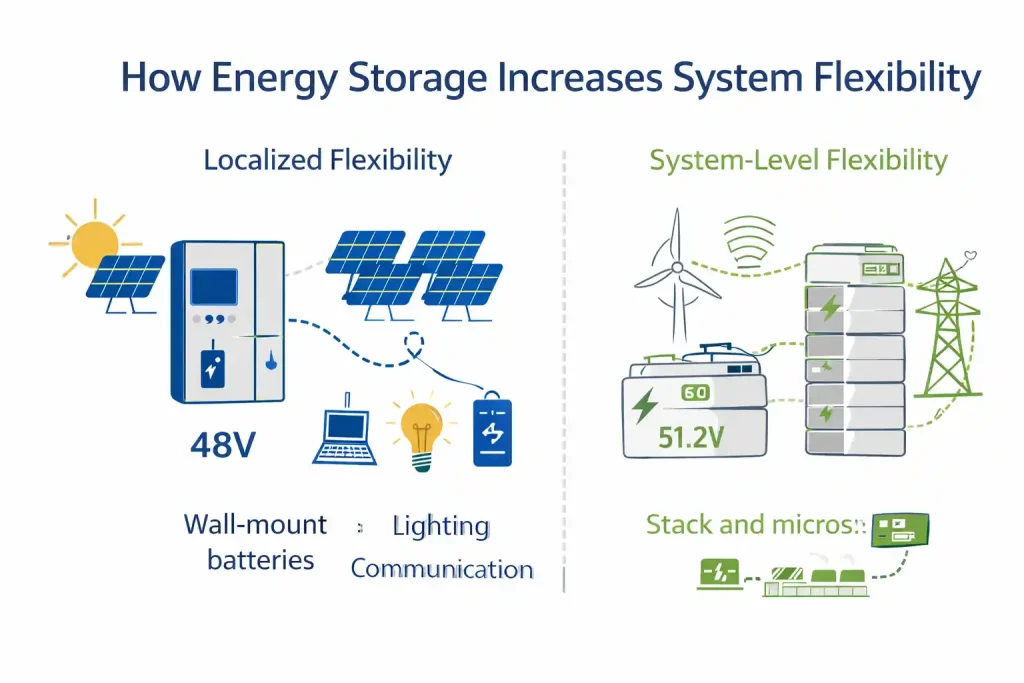
Smart homes vary widely in available space, layout constraints, and system design priorities. Wall-mounted and stackable energy storage configurations each serve different architectural needs.
Installation format should support ease of integration, efficient space usage, and future expansion while maintaining accessibility for maintenance and monitoring within the smart home environment.
Ensuring compatibility with solar and energy management systems
Home energy storage does not operate in isolation. It must integrate seamlessly with solar generation, inverters, and smart energy management platforms. Compatibility at the system level ensures that energy flows can be monitored, controlled, and optimized without complex retrofitting or fragmented control logic.
This interoperability is essential for maintaining a unified smart home energy ecosystem rather than a collection of disconnected components.
Evaluating long-term reliability and lifecycle performance
Smart homes are designed for continuous operation over long periods, and energy storage systems must meet the same expectation. Battery chemistry, cycle life, and thermal stability all influence long-term performance and maintenance requirements.
A well-selected home energy storage system supports consistent operation, predictable performance degradation, and reduced need for intervention over its service life.
Supporting future scalability and system evolution
Smart homes are rarely static. New devices, expanded automation, and additional renewable capacity often emerge over time. Home energy storage solutions that support modular expansion allow the energy system to evolve alongside the home itself.
This future-ready approach reduces redesign costs and ensures that the energy infrastructure remains aligned with long-term smart home development goals.
Conclusion
As smart homes continue to evolve toward greater intelligence, automation, and energy awareness, home energy storage becomes a foundational element rather than an optional addition. By enabling efficient energy control, improving system reliability, and supporting seamless solar integration, energy storage helps smart homes operate as cohesive, resilient energy systems.
When designed and selected with a system-level perspective, home energy storage supports not only today’s smart home requirements but also the flexibility and scalability needed for future expansion.
CARSPA provides home energy storage solutions designed to support smart home applications, including wall-mounted and stackable lithium battery systems built around long-term reliability, modular design, and solar integration compatibility.