
Why Is a Solar Charge Controller the Heart of Every Reliable Off-Grid Solar System?
Introduction
In the rapidly expanding world of renewable energy, off-grid solar systems have become one of the most practical and reliable ways to provide electricity in remote areas, industrial sites, and residential backup setups. Yet, the real stability and performance of these systems depend heavily on one crucial component — the solar charge controller.
A solar charge controller acts as the brain of the solar power system, managing how electricity flows from solar panels to the battery. Without it, batteries could easily be overcharged, discharged too deeply, or even damaged due to voltage fluctuations. By continuously monitoring input and output parameters, it ensures that every watt of solar energy is used efficiently and safely.
Modern solar charge controllers go far beyond simple voltage regulation. They now integrate MPPT (Maximum Power Point Tracking) technology, smart monitoring features, and multiple protection mechanisms that adapt to changing sunlight conditions. These advancements make them vital not just for small household systems, but also for commercial, agricultural, and industrial off-grid applications that require continuous and reliable power.

As the demand for sustainable power grows, understanding how a solar charge controller enhances performance, efficiency, and system lifespan has become essential for anyone looking to design or maintain a dependable off-grid energy system.
What Makes a Solar Charge Controller Essential in Off-Grid Solar Systems?
When it comes to designing an off-grid solar power setup, every component plays an important role — but the solar charge controller is the one that keeps the entire system balanced and protected. Acting as the central regulator, it controls how electricity from solar panels charges the batteries and powers connected loads. Without this device, even the most advanced solar panels could lead to battery overcharging, energy loss, or shortened battery lifespan.
1. Ensuring Safe and Stable Battery Charging
Solar energy output changes constantly with weather and sunlight intensity. A solar charge controller ensures that the battery receives only the right amount of current and voltage, preventing overheating or deep discharge. By regulating energy flow in real time, it keeps the system stable throughout the day.
2. Maximizing Solar Energy Utilization
Beyond protection, the controller's job is to make sure every bit of sunlight is efficiently converted into usable power. It optimizes charging conditions based on temperature, panel voltage, and load demand, ensuring consistent performance — especially in regions where solar irradiance fluctuates widely.
3. Extending the Lifespan of the Whole System
A well-calibrated charge controller can extend battery life by up to 30–40%, reduce maintenance costs, and improve the reliability of the entire solar system. It acts as a gatekeeper, balancing generation and storage to prevent both energy waste and equipment damage.
In short, the solar charge controller is not just a small electronic accessory — it is the core intelligence that ensures every off-grid solar installation operates safely, efficiently, and dependably.
How Does a Solar Charge Controller Protect Batteries and Improve System Efficiency?
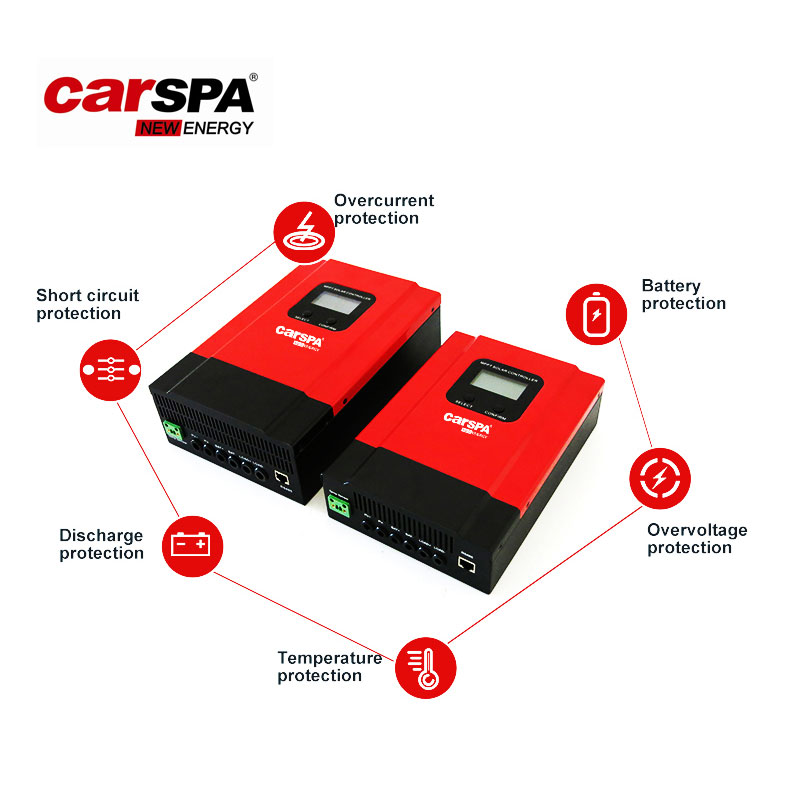
In an off-grid solar system, the battery bank is the energy reservoir, and the solar charge controller serves as its guardian and manager. Its core purpose is to ensure that batteries charge correctly, discharge safely, and perform efficiently over the long term. Without a properly configured controller, even high-quality batteries can degrade quickly or fail altogether.
1. Preventing Overcharging and Over-Discharging
When sunlight is abundant, solar panels generate more power than the battery can handle. The solar charge controller continuously monitors voltage and stops charging once the battery reaches its maximum safe level. Similarly, it prevents over-discharging by cutting off power when battery voltage drops too low. This dual protection is essential for maintaining battery health, stability, and lifespan.
2. Regulating Voltage and Current for Optimal Charging
Different types of batteries—such as lead-acid, AGM, gel, and lithium—require specific charging profiles. A modern solar charge controller automatically adjusts charging stages (bulk, absorption, float) to match the battery type. This ensures efficient energy transfer without causing heat buildup or chemical imbalance, improving both performance and safety.
3. Enhancing Energy Efficiency Through MPPT Technology
Advanced models equipped with Maximum Power Point Tracking (MPPT) technology can increase energy harvest by up to 30% compared to traditional PWM controllers. MPPT continuously tracks the ideal operating point of the solar array, converting excess voltage into usable charging current. This makes the system more efficient even in low-light or partially shaded conditions, maximizing the return on investment for any solar installation.
4. Providing Intelligent Protection and Monitoring
Many controllers now feature real-time data tracking, fault diagnostics, and communication interfaces (RS485, Wi-Fi, or Bluetooth). These allow users to monitor system health remotely, receive alerts for abnormal voltage or temperature, and adjust parameters as needed. Intelligent monitoring not only improves reliability but also reduces maintenance downtime, a key advantage for critical off-grid applications.
By combining protection, precision, and performance, the solar charge controller ensures that every watt generated by the solar array is safely stored and effectively used. It is this intelligent energy management that turns a basic solar setup into a truly efficient and long-lasting off-grid power system.
What Are the Main Types of Solar Charge Controllers and Their Key Differences?
Choosing the right type of solar charge controller is one of the most important steps in designing a reliable off-grid system. While all controllers perform the same core function—regulating the energy flow between panels and batteries—they differ significantly in technology, efficiency, and cost. The two main categories are PWM (Pulse Width Modulation) and MPPT (Maximum Power Point Tracking) controllers, each offering distinct advantages depending on system requirements.
1. PWM Solar Charge Controllers: Simple and Reliable
PWM controllers are the traditional type of charge regulation technology. They work by rapidly switching the power on and off to maintain the target voltage, ensuring safe charging.
Advantages:
Cost-effective and widely available.
Simple design with fewer components, resulting in long-term reliability.
Ideal for small-scale systems with lower voltage panels.
Limitations:
Efficiency typically ranges from 70%–80%.
Cannot convert excess voltage into additional charging current.
Less effective in cold or variable sunlight conditions.
PWM controllers are often used in basic solar lighting systems, small cabins, and RV setups, where cost and simplicity are priorities.
2. MPPT Solar Charge Controllers: Advanced and Efficient
MPPT controllers represent the modern standard in solar energy management. They use advanced algorithms to track the maximum power point of the solar array, converting surplus voltage into extra current for battery charging.
Advantages:
Up to 99% tracking efficiency and 30% higher energy harvest.
Performs exceptionally well in changing sunlight and temperature conditions.
Supports higher voltage panels and longer cable runs.
Limitations:
Higher initial cost.
Slightly more complex installation and setup.
MPPT controllers are best suited for large-scale off-grid homes, agricultural pumping systems, telecom towers, and industrial projects where consistent, efficient power generation is essential.
3. Choosing Between PWM and MPPT
The decision depends on system size, panel configuration, and budget. For example, a small solar lighting kit may not justify the higher price of MPPT, while a high-capacity battery bank in a remote power station can greatly benefit from its superior efficiency.
Ultimately, understanding these key differences helps ensure that your solar system runs at peak performance, with maximum protection and minimal energy waste.
How to Choose the Right Solar Charge Controller for Different Off-Grid Applications?
Selecting the correct solar charge controller is not just a technical choice—it determines how efficiently your off-grid solar system will perform over time. Different applications have distinct requirements in terms of voltage, current, environmental conditions, and energy demand. Below are the key factors and real-world examples to help guide the right selection.
1. Matching System Voltage and Current
Every solar charge controller has input voltage and current ratings that must align with the solar panels and batteries. For instance:
12V/24V systems: Common for small homes, RVs, and boats.
48V or higher systems: Used in industrial, agricultural, or telecom setups.
Choosing an undersized controller can cause overheating and system shutdowns, while an oversized one increases cost without added benefit. A well-matched setup ensures stable and efficient energy conversion.
2. Considering Application Environment
Environmental conditions can significantly affect controller performance.
High-temperature or dusty sites (like remote deserts or construction areas) require controllers with robust cooling design and IP-rated enclosures.
Humid or coastal zones should use corrosion-resistant materials and conformal-coated circuit boards.
Selecting a controller built for its environment reduces maintenance needs and enhances long-term reliability.
3. Evaluating Daily Load and Energy Usage
The size of your load—whether it's a lighting system, water pump, or telecom repeater—determines how much current the controller must handle. In applications with fluctuating energy demands, MPPT controllers offer superior adaptability by dynamically optimizing input from the solar array.
4. Choosing Based on Application Type
Residential cabins & small homes: PWM controllers are cost-effective and sufficient for basic power needs.
Agricultural water pumps & irrigation: MPPT controllers maximize power output during peak sunlight hours.
Telecommunication stations & off-grid monitoring: Require smart MPPT controllers with data logging, temperature compensation, and remote monitoring.
Industrial or hybrid systems: Often integrate multiple MPPT inputs and support high-voltage arrays for large battery banks.
5. Integration with Smart Monitoring Systems
Modern solar projects often require remote supervision. Controllers that support Wi-Fi, RS485, or mobile apps enable users to monitor energy flow, fault alerts, and performance trends in real time—critical for maintaining uptime in remote locations.
By understanding system size, usage environment, and technical demands, users can select a controller that not only fits their power goals but also guarantees safe, intelligent, and sustainable energy management.

Why Do Modern Off-Grid Projects Prefer Smart MPPT Solar Charge Controllers?
As solar technology continues to evolve, MPPT (Maximum Power Point Tracking) solar charge controllers have become the preferred choice for modern off-grid applications. Their combination of high conversion efficiency, intelligent system control, and adaptability to diverse environments makes them indispensable for both residential and industrial power systems.
1. Advanced Energy Harvesting Efficiency
Unlike traditional PWM controllers, MPPT controllers continuously track the optimal voltage and current point where solar panels produce maximum power. By converting excess voltage into additional charging current, they can increase energy yield by 20–30%, especially in cloudy weather or during temperature fluctuations. This efficiency improvement directly translates into faster charging and longer operation hours, even with limited sunlight.
2. Smart Control and Data Intelligence
Today's MPPT controllers integrate microprocessors and communication modules that enable real-time system monitoring and performance optimization.
Data Logging: Records energy generation and consumption trends for analysis.
Remote Access: Via Wi-Fi or RS485, users can check system status from mobile apps or cloud dashboards.
Automatic Protection: Intelligent fault detection prevents issues like reverse polarity, overcurrent, and temperature spikes.
These features are vital for remote off-grid sites where maintenance access is limited and reliability is paramount.
3. Scalability and System Flexibility
Modern MPPT controllers support a wide range of system voltages (12V to 96V and beyond) and can easily integrate with solar inverters, hybrid systems, or generator backups. This scalability allows users to expand power capacity as energy demands grow, without redesigning the entire setup.
4. Durability and Environmental Adaptability
Off-grid systems often operate in extreme conditions—from hot deserts to humid coastal zones. Smart MPPT controllers feature industrial-grade components, aluminum heat sinks, and adaptive thermal management, ensuring stable performance in harsh environments. Their robust design makes them suitable for telecom towers, agricultural water systems, rural electrification projects, and other critical applications.
5. Supporting the Future of Smart Energy Systems
With the global shift toward smart grids and connected devices, MPPT controllers are increasingly integrated into IoT-based energy management systems. They help users predict power availability, optimize load distribution, and maintain battery health automatically.
Conclusion
In today's solar-powered world, the solar charge controller is far more than a simple voltage regulator—it is the intelligent core of any off-grid system. Among all technologies, MPPT controllers stand out for their superior energy efficiency, smart management features, and long-term reliability.
Brands like CARSPA continue to innovate in this field, providing a range of high-performance MPPT solar charge controllers designed for diverse off-grid applications—ensuring stable, efficient, and sustainable power wherever it's needed most.




.jpg)

.jpg)
.jpg)
.jpg)
.jpg)
.jpg)


