
How Do Solar Charge Controllers Optimize Photovoltaic System Performance? 5 Critical Questions Answered
Introduction
Why Are Solar Charge Controllers Essential in Modern Photovoltaic Systems?
As photovoltaic systems continue to expand across residential, commercial, and industrial environments, the stability and efficiency of solar energy conversion have become increasingly dependent on advanced power-management components. Among these, the solar charge controller plays a central role by regulating the flow of energy from solar panels to the battery bank, ensuring that every watt of harvested sunlight is used effectively without causing damage to system components.

In modern PV applications, operational conditions change constantly—irradiance fluctuates throughout the day, temperature affects panel output, and load demand varies across different periods. A well-engineered solar charge controller ensures that the battery receives the optimal charging current and voltage at all times, adapting intelligently to real-time environmental and system conditions.
Beyond simple power regulation, today’s controllers are equipped with sophisticated algorithms, multi-stage charging profiles, and robust protection layers. These features not only enhance system reliability but also help users achieve higher energy yield, longer battery lifespan, and reduced maintenance costs. As PV installations continue to scale and technology evolves, the solar charge controller remains a critical foundation for sustainable and dependable solar-powered operation.
How Do Solar Charge Controllers Improve Energy Conversion Efficiency in PV Applications?
Modern photovoltaic systems depend heavily on how effectively they convert sunlight into usable electrical energy. A solar charge controller enhances this efficiency not only by managing charging behavior but also by optimizing how the PV array interacts with the battery and overall system. Several engineering mechanisms contribute to this improvement.
• Maximizing Energy Harvest Through MPPT or PWM Technology
The choice between MPPT (Maximum Power Point Tracking) and PWM (Pulse-Width Modulation) directly influences energy output.
MPPT controllers continuously track the optimal voltage-current point of the PV array, allowing the system to capture significantly more energy—especially during low irradiance or colder temperatures.
PWM controllers, while simpler, maintain steady charging for smaller systems and offer reliable performance at a lower cost.
• Stabilizing Power Flow in Fluctuating Sunlight Conditions
Solar radiation naturally fluctuates due to cloud movement, shading, and seasonal patterns. A high-quality controller dynamically adjusts charging parameters to stabilize the flow of energy.
This ensures consistent conversion efficiency and prevents drops in output that commonly occur when PV panels operate without intelligent regulation.
• Matching PV Output to Battery Requirements
Batteries have specific voltage and current characteristics that must be satisfied to charge efficiently.
The solar charge controller automatically adjusts PV input to match battery chemistry—such as AGM, GEL, LiFePO₄, or flooded batteries.
By ensuring optimal voltage levels, the controller reduces energy waste and supports full-capacity absorption.
• Reducing Thermal and Conversion Losses
Advanced controllers incorporate heat management, optimized circuit design, and high-frequency conversion to minimize internal losses.
Lower heat generation not only increases efficiency but also contributes to longer electronic component lifespan and overall system stability.
What Charging Modes and Control Strategies Ensure Stable Operation Under Variable Sunlight?
A solar charge controller must adapt to constantly changing environmental conditions, making its charging modes and control logic essential to maintaining consistent system performance. Through advanced charging profiles and intelligent decision-making, the controller ensures stable battery operation and efficient utilization of solar energy throughout the day.
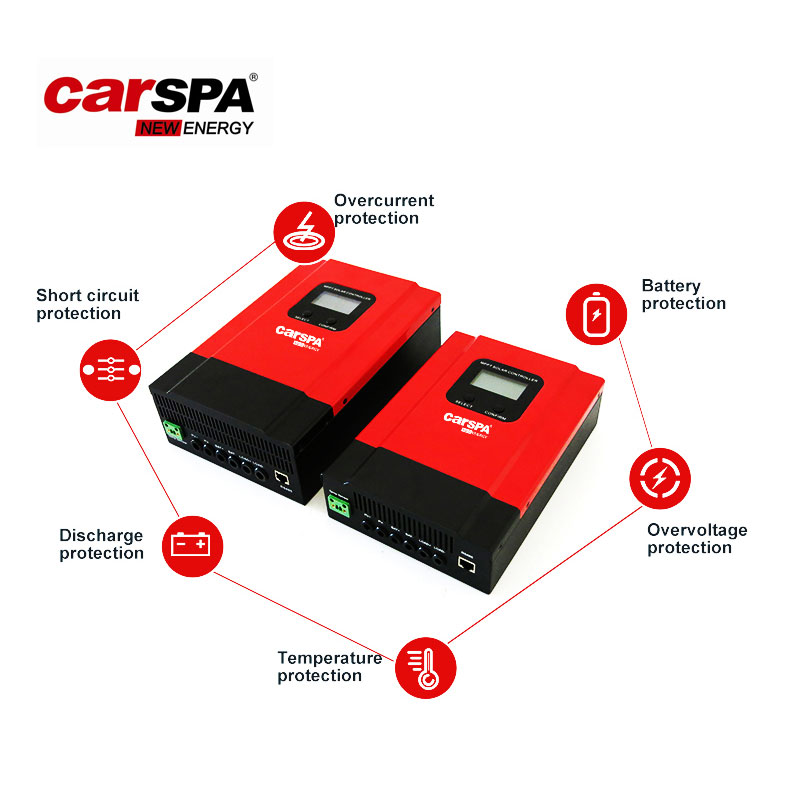
• Multi-Stage Charging for Higher Battery Stability
Modern controllers use multi-stage charging—typically including Bulk, Absorption, Float, and sometimes Equalization—to match the real-time needs of the battery.
Bulk Mode rapidly delivers current as sunlight availability increases.
Absorption Mode holds a controlled voltage to prevent battery stress during the final charging phase.
Float Mode maintains battery charge without overcharging, ideal for long-duration stability.
These stages work together to enhance battery reliability and prevent premature aging.
• Adaptive Algorithms for Unpredictable Sunlight Conditions
Sunlight can change instantly due to shading, passing clouds, or panel-angle variation.
A well-designed solar charge controller continuously analyzes PV voltage and battery status, adjusting parameters in milliseconds.
This adaptive behavior keeps the system stable, reduces charge interruptions, and improves overall battery health—especially in climates with high irradiance fluctuation.
• Temperature Compensation for Accurate Charging
Battery performance is highly sensitive to temperature.
To address this, advanced controllers integrate temperature compensation, automatically modifying charging voltage according to real-time temperature readings.
This prevents undercharging in cold environments and overcharging in hot environments, supporting stable long-term operation in diverse climates.
• Load Control Strategies That Balance Demand and Supply
In off-grid or hybrid systems, the controller may also manage DC loads directly.
By using programmable load outputs, the controller can prevent excessive battery discharge, optimize nighttime consumption, and ensure critical loads remain powered even in low-sunlight periods.
How Do Protection Features Enhance System Reliability and Extend Component Lifespan?
In photovoltaic systems, protection mechanisms are essential for preventing system failures, reducing maintenance costs, and ensuring long-term operational safety. A solar charge controller integrates multiple layers of protection that safeguard both the battery and the entire PV installation from electrical, thermal, and environmental risks.
• Overcharge and Over-Discharge Protection for Battery Longevity
Batteries are particularly vulnerable to improper charging.
Overcharge protection prevents excessive voltage from damaging battery plates and electrolyte levels.
Over-discharge protection stops the battery from falling below safe voltage thresholds.
Together, these features prolong battery life and maintain consistent energy availability throughout daily charge-discharge cycles.
• Short-Circuit and Overcurrent Safeguards for System Safety
PV arrays can generate high current levels, especially under strong sunlight.
A solar charge controller equipped with short-circuit and overcurrent protection ensures that abnormal surges do not damage internal circuits, downstream equipment, or external loads.
These protections help avoid costly failures and reduce the risk of operational downtime.
• Reverse Polarity Protection for Installation Reliability
Incorrect wiring during installation is a common source of system malfunction.
With reverse polarity protection, the controller prevents damage when PV or battery leads are connected incorrectly.
This not only improves installation reliability but also enhances user safety and reduces troubleshooting time.
• Over-Temperature Protection for Safer Component Operation
Solar charge controllers operate in high-heat environments—especially outdoor enclosures or areas exposed to direct sunlight.
Thermal sensors monitor internal temperature, enabling the controller to reduce charging current or shut down temporarily when overheating occurs.
This protects sensitive components and ensures stable performance in demanding conditions.
• Lightning and Surge Protection for Harsh Environments
Outdoor PV installations are exposed to spikes caused by lightning or grid disturbances.
Surge protection circuits help absorb sudden voltage peaks, preventing damage to the controller, battery, and connected loads.
This makes the system more resilient, especially in remote or weather-intensive locations.
Which Installation and Configuration Practices Lead to Optimal Performance in Solar Power Systems?
Even the most advanced solar charge controller can only deliver peak performance when properly installed and configured. Correct system planning, accurate wiring, and optimized parameter settings ensure that the PV array, batteries, and loads operate efficiently and safely. The following practices are essential for achieving reliable long-term operation.
• Selecting the Right Controller Size for System Requirements
System capacity directly determines the type and rating of the solar charge controller.
PV array voltage and current must match the controller’s allowable input range.
Battery voltage (12V / 24V / 48V) must be supported by the model.
Load requirements influence whether additional features such as load terminals are needed.
Correct sizing prevents overload, ensures efficient charging, and minimizes heat generation.
• Ensuring Proper Wiring and Cable Management
High-quality wiring is critical for energy stability and safety.
Use cables with adequate cross-sectional area to reduce voltage drop.
Keep PV, battery, and load connections tight and corrosion-free.
Separate low-voltage signal wires from high-current cables to reduce interference.
Proper wiring lowers losses, enhances protection function accuracy, and supports long-term system durability.
• Installing the Controller in a Ventilated, Protected Location
Solar charge controllers generate heat, especially during high-current operation.
They should be mounted in:
A cool, dry, and shaded environment
A vertically oriented position for natural heat dissipation
Enclosures with adequate airflow
Avoiding direct sunlight and excessive humidity prolongs the lifespan of electronic components and reduces thermal stress.
• Choosing Correct Battery Type Settings for Accurate Charging
Most modern controllers support multiple battery chemistries, including AGM, GEL, lithium, and flooded batteries.
Selecting the correct type ensures accurate charging voltage, safe thermal behavior, and optimal battery performance.
Incorrect settings may lead to reduced capacity, overheating, or shortened battery lifespan.
• Configuring System Parameters to Match Application Needs
Advanced controllers allow fine-tuning of:
Float and absorption voltages
Load output timing
Low-voltage disconnect thresholds
Temperature compensation coefficients
Customizing these parameters enables the system to meet specific operational goals—such as maximizing nighttime load time or extending battery service life.

Conclusion
What Makes a High-Quality Solar Charge Controller a Long-Term Investment for PV Projects?
A well-engineered solar charge controller is far more than a simple power-regulation device—it is the operational backbone that ensures photovoltaic systems run efficiently, safely, and reliably over many years. By intelligently managing charging behavior, optimizing energy conversion, protecting batteries from harmful conditions, and stabilizing performance under variable sunlight, the controller significantly enhances both system output and component lifespan.
As PV installations grow in scale and complexity, the value of a dependable controller becomes even more evident. Long-term reliability, smart charging algorithms, durable construction, and versatile configuration options all contribute to improved efficiency and reduced maintenance costs. Whether deployed in off-grid cabins, industrial energy systems, rural electrification, or hybrid solar setups, the right controller ensures consistent performance and sustained energy availability.
For projects seeking proven stability and engineering-grade performance, solutions from CARSPA provide the robust control, safety features, and long-term durability required for modern photovoltaic applications—making them a solid investment for any solar power system.


