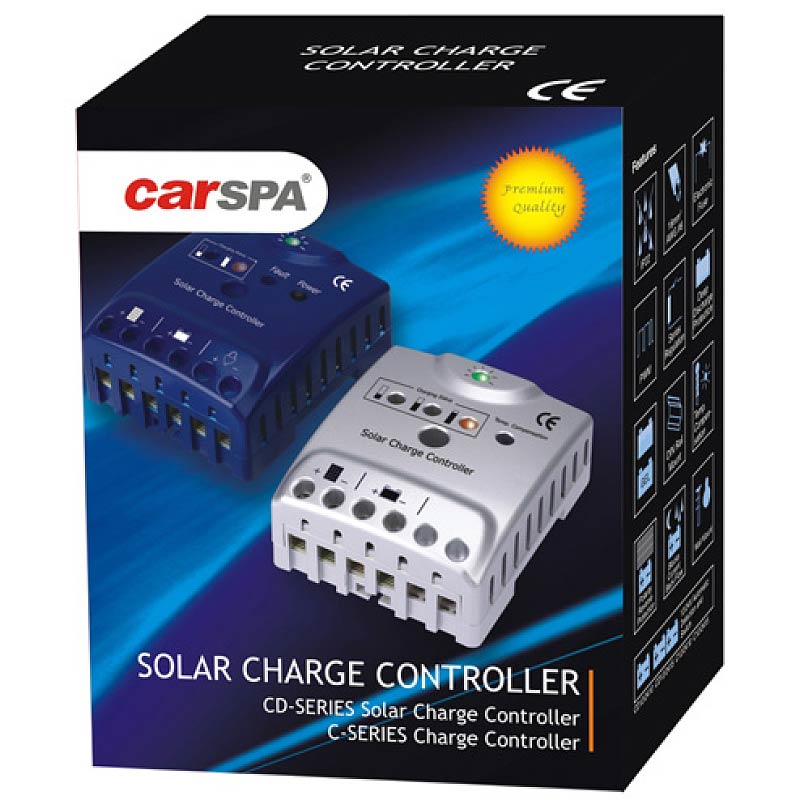
How Does a Solar Charge Controller Work and What Are the differences between MPPT and PWM?1 Table Tells You
Solar energy systems are increasingly used in industrial applications to provide clean and reliable power. A crucial component in any solar setup with battery storage is the solar charge controller. This device sits between the solar panels and the battery bank, regulating the flow of electricity. In this article, we'll explain how a solar charge controller works, explore the two main types (PWM and MPPT), and discuss the key benefits of using a solar charge controller in industrial-scale solar systems.
What Exactly Does a Solar Charge Controller Do?
A solar charge controller—sometimes called a solar charge regulator—is a critical electronic component in any solar power system. Its job is to manage how electricity from the photovoltaic (PV) solar panels is delivered to the batteries. Think of it as a smart gatekeeper: it carefully regulates the voltage and current to ensure batteries are charged efficiently without risking overcharge or damage. This controlled charging process not only protects the batteries but also helps prolong their lifespan by keeping them within a healthy charge range.
Without this control, solar panels would send unfiltered energy straight to the batteries. That might sound productive, but in reality, it could lead to dangerous overcharging, damaging not only the batteries but possibly connected devices as well. A quality solar charge controller prevents such risks. In fact, experts caution that if a PV array feeds power directly into the battery system without regulation, it can overwhelm and destroy both the batteries and the loads. Simply put, the charge controller is essential for safe and efficient system operation, acting as a safeguard against overcharging, deep discharge, and other power-related hazards.

How Is a Solar Charge Controller Installed in a Solar Power System?
In a typical solar setup, the charge controller is positioned between the solar panels and the battery bank—and often between the batteries and the system's DC loads. It constantly monitors the battery voltage to decide how much current should flow. When the sun is shining and panels are generating electricity, the controller sends power to the batteries. As the batteries near full charge, the controller tapers the current or stops charging altogether to avoid going over the limit. Some advanced controllers also handle discharge management: if loads are connected through the controller's terminals, it can automatically disconnect them when voltage drops too low, protecting the battery from being drained excessively.
At night or during cloudy conditions when the solar panels aren't generating electricity, the controller includes components like blocking diodes or similar circuits to stop the battery from discharging back into the panels. Most modern charge controllers are also equipped with built-in protections against short circuits, reverse polarity, and high temperatures, all of which contribute to overall system safety and reliability.
System Layout Visualization
A basic diagram of a solar charge controller's role would show it at the center of the system, situated between the solar array on one side, the battery bank underneath, and the loads on the other. Its function is to manage the energy path—ensuring the battery gets what it needs without being pushed beyond safe limits, while also keeping power reliably flowing to connected devices.
In industrial or commercial-grade solar systems, charge controllers often come with additional features such as LCD status screens, programmable settings, and remote monitoring interfaces. However, regardless of the model or complexity, their core mission remains the same: to manage the flow of energy in a safe, intelligent, and battery-friendly way.
How Does a Solar Charge Controller Work?
To understand how a solar charge controller operates, it helps to break down both its functionality and the types of technology it uses. At its core, every controller manages voltage and current levels to ensure safe, effective battery charging. When battery levels are low, the controller allows maximum current from the panels. As the battery approaches full charge, it reduces the current and switches to a maintenance or “float” stage to prevent overcharging. Most modern controllers use a multi-stage charging process—typically including bulk, absorption, float, and sometimes equalization (especially for lead-acid batteries)—to optimize battery health and performance over time.
There are two primary types of controllers used in solar systems today: PWM (Pulse Width Modulation) and MPPT (Maximum Power Point Tracking). Both serve the same purpose—managing the flow of solar energy to the batteries—but they go about it differently and are suited for different setups. Below is a breakdown of how each type works, followed by a detailed comparison.
What Is a PWM (Pulse Width Modulation) Charge Controller?
PWM charge controllers are among the most widely used and budget-friendly options in solar power systems. Their operation is based on a straightforward concept: they act like an automatic electrical switch between the solar panels and the battery. When the battery requires charging, the controller connects the solar array directly to it. As the battery nears its target voltage, the controller rapidly switches the connection on and off to maintain the battery at the correct voltage, preventing overcharging. This switching behavior—modulating how long the connection stays on or off—is what gives Pulse Width Modulation (PWM) its name.
In real-world use, a PWM controller pulls the solar panel's voltage down to closely match the battery's charging voltage. For example, if you have a 12V battery that charges around 14–15V, the solar panels will be forced to operate at that same voltage while charging. This means the controller does not convert voltage; it simply regulates the connection based on the battery's needs. As a result, any excess panel voltage goes unused, since the panel is locked to the battery's voltage level.
Key Characteristics of PWM Controllers:
1. Simplicity and Cost-Effectiveness
PWM controllers are built with fewer components, which makes them both affordable and highly reliable. This simplicity means there's less that can go wrong, which is particularly valuable in remote or rugged locations where system maintenance is difficult. They are commonly used in small to mid-sized systems where the panel voltage is well-matched with the battery bank.
For instance, a typical 12V solar system may use PV modules with a Vmp (Voltage at Maximum Power) of about 18V—this pairs efficiently with a 12V battery and allows a PWM controller to connect them directly without significant energy loss.
2. Limitations on Panel Voltage Compatibility
One major constraint of PWM controllers is their need for voltage matching between the panel and battery. Since they don't actively step down voltage, you can't use high-voltage solar arrays with low-voltage batteries. For example, connecting a PV array with a Vmp (Voltage at Maximum Power) of 30V to a 12V battery would result in wasted energy, because the controller will clamp the panel's output down to the battery's voltage.
To avoid this, panels must be chosen or wired in configurations that match the nominal system voltage (e.g., 12V, 24V, or 48V). This makes PWM setups less suitable for larger or more complex systems using high-voltage arrays.
3. Efficiency Considerations
PWM controllers are less efficient than MPPT types in converting solar energy, especially in colder climates or when panel voltage is significantly higher than battery voltage. For example, in cold weather, a 12V panel might naturally have a Vmp (Voltage at Maximum Power) of around 18V, while the battery is at 12–14V. The controller will clamp the panel to the lower voltage, leaving the difference unused.
This voltage mismatch can lead to 10–30% lower energy harvest compared to the panel's rated capacity. In warm or tropical environments where the panel voltage stays closer to the battery voltage, PWM efficiency loss is less significant—making it a viable solution for such climates.

What Is an MPPT (Maximum Power Point Tracking) Charge Controller?
MPPT controllers are the more advanced option, built to maximize the power harvested from solar panels. These units include a DC-DC converter and a microprocessor that constantly searches for the array's “maximum power point”—the ideal voltage-current combination that yields the most power. MPPT technology decouples the solar panel voltage from the battery voltage, allowing it to take higher-voltage input from the panels and step it down to match the battery. This increases the current and improves efficiency.
Think of MPPT as a power-optimizing gearbox. If your panels are putting out 36V at 5A (180W) and your battery is at 12V, the MPPT controller converts the incoming power into a roughly 12V output at 15A—still about 180W, minus conversion losses. This means more of your panel's potential is used rather than wasted.
Key Advantages of MPPT Controllers:
Higher Efficiency: MPPT controllers can deliver up to 30% more energy compared to PWM units, especially in colder temperatures or when the PV array voltage is significantly higher than the battery voltage. Most systems see 20–25% more energy yield in temperate zones, and around 10% in tropical climates.
Supports Higher Voltage Panels: MPPT units allow you to wire panels in series for higher voltages—150V or more isn't unusual. The controller then steps this down to match your 12V, 24V, or 48V battery bank. This reduces wire losses, simplifies layouts, and supports longer cable runs in large installations.
Adaptive Performance: MPPT algorithms dynamically respond to real-time conditions like cloud cover, partial shading, or temperature swings. This means your system can still operate near its peak even on overcast days or early in the morning.
Considerations When Using MPPT:
Higher Cost and Complexity: MPPT controllers are more expensive than PWM and have more electronic components, which can raise the risk of failure over time. They also generate more heat, which must be managed with proper ventilation or heatsinks.
Bigger Investment, Better Return: While the upfront cost is higher, the improved energy harvest often justifies it—especially for medium-to-large solar systems where every watt counts.
Given the shift toward higher-capacity solar arrays and more demanding industrial energy needs, MPPT controllers are increasingly becoming the standard. However, PWM charge controllers still have a niche in smaller, budget-sensitive setups.
PWM vs. MPPT: Comparison Table
To summarize the differences between PWM and MPPT charge controllers, the table below highlights key aspects of each approach and how they affect performance and usage:
Key Differences at a Glance
| Aspect | PWM Charge Controller | MPPT Charge Controller |
| How It Works | Acts like a switch, connecting the panel directly to the battery. Panel voltage is pulled down to match battery. | Uses DC-DC conversion to track the panel's maximum power point and optimize power delivery to the battery. |
| Charging Efficiency | Basic and less efficient. If panel voltage > battery voltage, the extra energy is lost. Works best when panel voltage ≈ battery voltage. | Highly efficient. Converts nearly all available solar power (typically 95–99% efficiency), even with high panel voltages. |
| Best For | Small systems with matching panel and battery voltages (e.g., 12V + 12V). Not ideal for high-voltage arrays. | Larger systems. Can handle high-voltage solar arrays and convert power for lower-voltage batteries (12V/24V/48V+). |
| Cost & Complexity | Low cost, simple design, minimal heat, easy to maintain. | Higher cost, more complex electronics, needs better thermal and EMI design, but delivers more energy in return. |
| Features | Basic protections (overcharge, possibly low-voltage disconnect). Limited data or smart features. | Often includes custom charging profiles, remote monitoring, and smart integration with inverters and energy systems. |
Summary
Both PWM and MPPT charge controllers ensure batteries are charged safely. The main differences lie in energy efficiency, voltage compatibility, system scalability, and price.
For simple, budget-friendly setups, PWM remains a viable choice. But for larger, industrial, or high-performance systems, MPPT is increasingly the preferred standard—especially where every watt of solar energy counts.

Find the Right Balance Between Efficiency and Simplicity
Choosing between PWM and MPPT solar charge controllers ultimately depends on your system size, budget, and performance goals. For smaller, well-matched solar setups, a PWM controller offers reliable operation at a lower cost. But when higher efficiency, flexibility in panel configuration, or performance under variable conditions matters, MPPT controllers often deliver better long-term value.
Both technologies play a critical role in protecting your batteries and ensuring stable energy flow. By understanding how they work and where each one excels, you're better equipped to build a solar power system that fits your specific needs.
If you're looking for dependable, well-engineered charge controllers, CARSPA offers a full line of both PWM and MPPT models—built for everything from residential setups to demanding industrial environments. Each product is designed to deliver long-lasting performance, safe charging, and ease of integration.