
Why Every Solar Power System Needs a High-Performance Solar Charge Controller?5 Critical Questions Answered
In today's energy-conscious world, solar power systems have become a cornerstone of sustainable electricity generation—powering everything from off-grid cabins and remote farms to mobile vehicles and critical infrastructure. But behind every efficient and reliable solar setup lies a component that is often overlooked yet absolutely essential: the solar charge controller.
A solar charge controller is responsible for regulating the flow of electricity from solar panels to batteries. It prevents overcharging, undercharging, and power fluctuations that can shorten battery life or disrupt energy availability. Whether you're building a small portable system or designing a full-scale off-grid installation, selecting the right charge controller is crucial for protecting your investment and maximizing energy yield.
In this article, we explore the key questions surrounding solar charge controllers:
Why are they essential in modern solar systems?
What types are available, and how do they differ?
How do they improve system efficiency and battery performance?
What factors should you consider when selecting one?
And where are these controllers most commonly deployed?
By the end, you'll have a clear understanding of how to choose the best solar charge controller for your specific application—and why working with a trusted brand like CARSPA makes all the difference.
Why Is a Solar Charge Controller Essential in Any Solar Power System?

Protecting Your Battery Investment
A solar charge controller serves as a vital safeguard between the solar panels and your battery bank. Solar panels can produce voltage levels that exceed what a battery can safely handle—especially under direct sunlight or rapid irradiance changes. Without a charge controller in place, this overvoltage could lead to overheating, internal damage, or even explosion in sensitive battery types like lithium iron phosphate (LiFePO₄). Overcharging not only reduces battery efficiency but significantly shortens its usable life.
Equally important is preventing deep discharge, which can occur if a load draws too much energy from the battery overnight or in low sunlight conditions. Most quality controllers have built-in low-voltage disconnect (LVD) functionality that automatically cuts off the load once the battery reaches a critical threshold, thereby preserving battery capacity and extending its lifespan.
Balancing Efficiency and Longevity
Beyond protection, a charge controller ensures that batteries are charged using industry-standard multistage charging methods—typically bulk, absorption, and float phases. During the bulk phase, the battery receives maximum current to rapidly restore charge. In the absorption phase, voltage is held steady while current decreases, ensuring full saturation of cells. Finally, the float stage keeps the battery at full charge without overloading it.
These intelligent charging cycles are especially beneficial for off-grid or hybrid systems that rely heavily on battery autonomy. Whether using lead-acid or lithium batteries, maintaining the ideal charging profile prevents sulfation, overheating, and premature capacity loss.
Safety in Operation
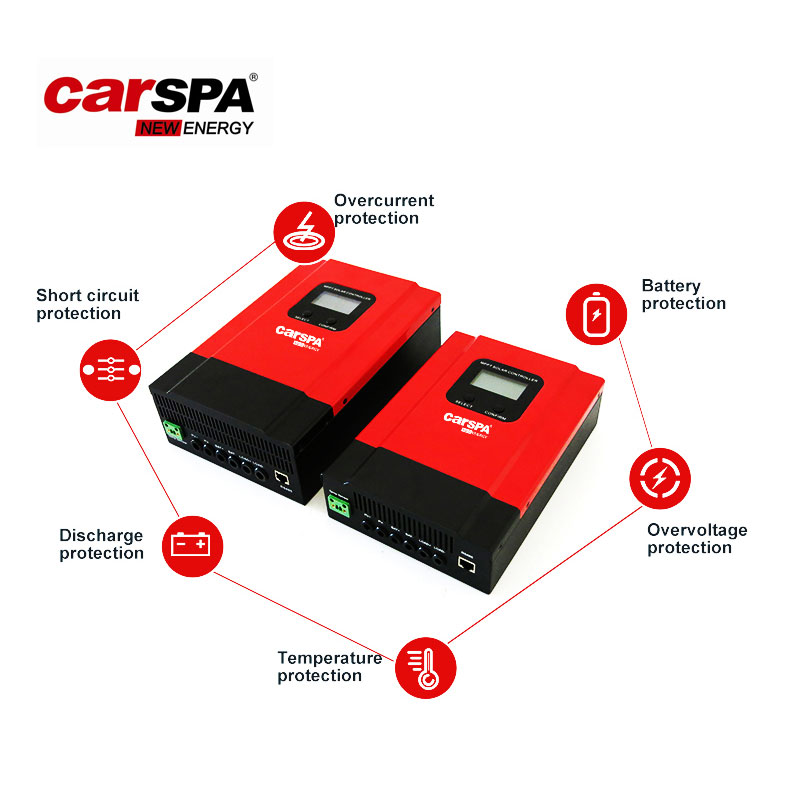
Modern solar charge controllers are engineered with comprehensive protection circuits, including short-circuit prevention, reverse polarity correction, over-temperature shutoff, and internal fuse protection. These features are indispensable for installations in remote or unattended locations, where rapid human intervention is not always possible.
Furthermore, most commercial-grade controllers include temperature compensation—an automatic adjustment of charging voltage based on ambient temperature. This is particularly important in extreme environments where battery voltage requirements change with seasonal or daily temperature fluctuations.
Together, these capabilities ensure that your solar energy system not only operates efficiently but also reliably—delivering maximum return on your renewable energy investment.
What Are the Main Types of Solar Charge Controllers?
PWM (Pulse Width Modulation)
PWM (Pulse Width Modulation) controllers are the more traditional and cost-effective solution in solar energy systems, particularly in low- to medium-power applications. They work by connecting the solar panel array directly to the battery bank and rapidly “pulsing” the power on and off to maintain the target voltage. As the battery nears full charge, the width of the pulse narrows, reducing current flow and preventing overcharging.
PWM controllers are simple, durable, and highly efficient when the solar panel voltage matches the battery voltage. For example, in 12V systems with 12V panels, PWM is an excellent choice. However, they become less effective in systems with higher voltage panels or longer cable runs, as excess panel voltage is lost rather than converted. That makes them less suitable for large off-grid homes or commercial solar farms.
Common applications for PWM controllers include:
Small lighting systems (e.g., solar street lights)
Mobile or portable solar setups (e.g., RVs and boats)
Agricultural monitoring stations with DC power demand
MPPT (Maximum Power Point Tracking)
MPPT (Maximum Power Point Tracking) controllers represent the next generation of charge control technology. They are designed to continuously monitor and track the maximum power point of a solar panel array—i.e., the voltage and current combination at which the panels produce the most power. MPPT controllers then convert that power to the optimal voltage and current required to charge the battery efficiently.
One of the major advantages of MPPT technology is its ability to step down higher-voltage solar input (e.g., 48V or 72V arrays) to charge lower-voltage battery systems (e.g., 12V or 24V). This allows for more flexible and space-efficient solar panel configurations while reducing power loss in long-distance cabling. In cold climates, where panel voltage tends to spike, MPPT systems can capture up to 30% more energy than PWM alternatives.
Ideal MPPT use cases include:
Medium to large off-grid homes or solar farms
Industrial or agricultural water pump systems
Commercial buildings with complex solar arrays
EV charging stations using solar energy
Choosing the Right Type
The choice between PWM and MPPT should be guided by your system's power requirements, budget constraints, panel configuration, and environmental conditions.
For small, low-cost systems with matched voltages, PWM remains a reliable and economical choice.
For higher-efficiency, flexible designs, or when space and sunlight are limited, MPPT delivers significantly higher performance despite its higher initial cost.
Ultimately, selecting the right type of solar charge controller is not just about price—it's about ensuring long-term system efficiency, adaptability, and protection.
How Does a Solar Charge Controller Improve Energy Efficiency?
Optimal Power Transfer with MPPT Technology
One of the most significant benefits of modern solar charge controllers—particularly MPPT controllers—is their ability to maximize energy harvest from solar panels. Unlike PWM controllers, which simply reduce excess voltage, MPPT models convert that excess into usable charging current. This DC-DC conversion enables the system to deliver more amperage to the battery without increasing panel surface area.
For example, in a 1000W solar array where panel voltage is 48V and battery voltage is 24V, an MPPT controller can down-convert the voltage while increasing the current—maintaining nearly 99% of the original power. This becomes even more important during early morning, cloudy, or winter conditions, when irradiance fluctuates and panel voltage doesn't always align with battery needs. In such situations, MPPT controllers consistently outperform PWM models by 15–30% in energy transfer.
Intelligent Load Control Functions
Advanced solar charge controllers come equipped with programmable load terminals, allowing for direct control of connected DC loads. This feature enables users to:
Automatically turn on lighting systems after sunset
Disconnect non-essential equipment when battery voltage drops
Prioritize critical devices like communication or water pumps during limited energy availability
Such intelligent load control contributes to energy prioritization, minimizing waste and extending battery life by preventing deep discharge events. This is particularly useful in unattended systems or remote installations where manual load management is impractical.
Real-Time System Optimization
Another key efficiency enhancement comes from real-time performance monitoring. Many modern controllers include:
Digital LCD displays showing voltage, current, state of charge (SOC)
USB or RS485 ports for connection to external monitors or PLCs
Bluetooth or WiFi modules for app-based remote control
These interfaces allow system operators or maintenance personnel to track solar yield, monitor battery status, and diagnose issues early, reducing downtime and optimizing charge schedules. For large or mission-critical systems, such as telecommunications stations or rural microgrids, this real-time data becomes essential for performance tuning and troubleshooting.
Environmental Adaptability
High-efficiency controllers also adapt to temperature and weather fluctuations. Features such as temperature compensation sensors ensure that charging voltage is adjusted automatically as the ambient temperature changes. This prevents battery overcharging in hot environments or undercharging in cold regions—both of which impact long-term system reliability and energy throughput.
In summary, by combining advanced power conversion, intelligent load handling, real-time diagnostics, and environmental response mechanisms, a high-quality solar charge controller dramatically improves the overall efficiency of your solar energy system—leading to reduced energy waste, optimized battery usage, and lower total cost of ownership over time.
What Should You Consider When Selecting a Solar Charge Controller?
Voltage and Current Ratings: Matching System Requirements
The first and most critical step in choosing a solar charge controller is ensuring that its voltage and current ratings are compatible with your solar array and battery system.
For system voltage, the controller must support your battery bank voltage (typically 12V, 24V, 48V, or higher in industrial setups).
For input voltage, MPPT controllers offer more flexibility, allowing you to connect higher-voltage solar arrays to lower-voltage batteries.
The current rating should exceed the total current produced by your solar panels at peak power. For instance, a 40A controller should not be paired with an array producing 50A under full sunlight.
It's also wise to include a 20–25% safety margin when calculating ampere needs, to account for temperature fluctuations, panel performance spikes, or future expansion.
Compatibility with Battery Type and Chemistry
Not all batteries charge the same way. A high-quality charge controller must either support your battery chemistry (Lead-Acid, Gel, AGM, Lithium-ion, LiFePO₄, etc.) or allow programmable charge profiles.
Each battery type has specific charging voltage thresholds, float requirements, and safety limits:
Lead-acid batteries require multi-stage charging with float modes to prevent sulfation.
Lithium batteries benefit from precise voltage regulation and usually don't require float charging.
Gel batteries are sensitive to overvoltage and need lower charging currents.
If your system uses lithium or other advanced chemistries, ensure your controller supports customizable charging parameters and includes features like low-temperature charging protection and cell balancing compatibility.
Environmental Durability and Installation Conditions
In harsh outdoor environments—common in agriculture, telecom towers, or remote energy stations—the controller must withstand environmental stress. Look for:
IP65 or higher rating for protection against dust and water ingress
Wide temperature tolerance (e.g., -20°C to +60°C) for desert or cold climate use
UV-resistant, corrosion-proof casing for long-term outdoor exposure
Passive or active cooling mechanisms to prevent thermal shutdown in high-current applications
Additionally, consider physical installation:
Is there adequate ventilation in the enclosure?
Is the controller DIN-rail or wall-mountable?
Does it support top/bottom wiring for cabinet integration?
Smart Features and Future Scalability
If your solar project is expected to grow—or you want a controller that offers more than just basic regulation—look for smart features that enhance system control and diagnostics:
Remote monitoring via mobile apps or web dashboards
Battery temperature sensors and data logging capabilities
Communication protocols like RS485, CAN, or MODBUS
Parallel operation support for larger systems with multiple controllers
These features not only make maintenance easier but also allow for centralized energy management—crucial in microgrid or hybrid solar-diesel setups.
In conclusion, selecting the right solar charge controller is not just a technical task—it's a strategic decision that influences system longevity, energy efficiency, and operational reliability. A well-matched controller protects your investment and ensures your solar system continues to deliver optimal performance year after year.

Where Are Solar Charge Controllers Commonly Used?
Off-Grid Homes and Cabins
One of the most prevalent applications of solar charge controllers is in off-grid residential systems, such as cabins, rural homes, and vacation lodges. In these locations, access to reliable grid power is often nonexistent or too expensive to install. Solar power systems become the primary energy source, and the charge controller plays a critical role in ensuring:
Stable battery charging over day-night cycles
Protection against over-discharge during long periods of cloudy weather
Efficient use of solar input even during variable irradiance conditions
MPPT controllers are particularly favored in this context, as they allow users to harvest more energy from limited roof space or portable solar setups. Many homeowners pair charge controllers with inverters and deep-cycle lithium batteries, creating a complete micro-power solution that can power lights, appliances, and communication systems.
Agricultural and Irrigation Systems
In rural farming operations, solar-powered water pumps, fencing systems, and crop monitoring sensors increasingly rely on solar energy. Solar charge controllers are indispensable in these setups, where unattended operation and long runtimes are common.
For example, in solar irrigation systems:
The controller ensures that water pumps receive consistent power throughout the day.
Load terminals can automate pumping schedules based on solar availability.
Battery banks are protected from deep discharges overnight, maintaining performance over multiple seasons.
These systems often operate under harsh weather, making durability, temperature compensation, and waterproof design key controller features. Agricultural users also appreciate low-maintenance operation, especially when systems are deployed across large farmland.
Mobile and Marine Applications
Solar charge controllers are also widely used in mobile power systems, including RVs, motorhomes, caravans, and boats. These environments require compact, lightweight, and energy-efficient controllers that can handle rapidly changing solar conditions and irregular energy loads.
Marine solar setups, in particular, benefit from:
Corrosion-resistant enclosures
High IP ratings to withstand saltwater exposure
Battery charge profiles suitable for deep-cycle marine batteries
Many of these systems use 12V or 24V configurations, making PWM controllers suitable for simple setups, while more power-demanding RVs or boats may benefit from MPPT units, especially when equipped with multiple appliances, fridges, or AC inverters.
Commercial and Remote Installations
In industrial and telecommunications sectors, solar charge controllers are embedded in remote monitoring stations, surveillance towers, road signage systems, and oil pipeline sensors. These systems often run 24/7 in environments far from human intervention.
In such mission-critical applications, solar charge controllers must offer:
Redundancy and reliability
Remote data access and diagnostics
Compatibility with large battery banks
Smart alert functions for power failures or battery voltage drop
For example, in telecom BTS (base transceiver station) backup systems, solar controllers ensure that communication equipment remains powered during outages, reducing downtime and minimizing operational risk.
Conclusion
From mountain cabins and coastal boats to agricultural fields and industrial towers, solar charge controllers are the hidden engine behind stable and efficient solar power systems. Their ability to regulate charging, protect batteries, and intelligently manage loads makes them indispensable across countless applications.
For reliable, feature-rich, and application-ready solutions, CARSPA offers a full range of PWM and MPPT solar charge controllers. Their products are engineered for durability, efficiency, and compatibility—ensuring you get the most out of every ray of sunlight.


