
Key Facts on Energy Storage for Flexible and Stable Power Systems
Introduction
Energy Storage is no longer a niche technology or a simple backup solution. It has become one of the most important foundations of modern power systems as electricity networks transition toward higher levels of renewable generation, electrification, and decentralized energy production.
In traditional power systems, electricity was generated, transmitted, and consumed in a relatively predictable way. Large power plants adjusted their output to match demand, and the grid remained stable because supply could be controlled directly. That model is now changing. Solar and other renewable sources produce energy based on environmental conditions rather than demand patterns. As a result, power systems must handle constant fluctuations in generation, load, and power flow.
This shift is why Energy Storage has become a central element in future-ready power architectures. By storing electricity when it is available and releasing it when it is needed, storage creates a time-bridge inside the energy system. This ability transforms intermittent renewable power into a stable, usable energy resource that can support real-world applications.
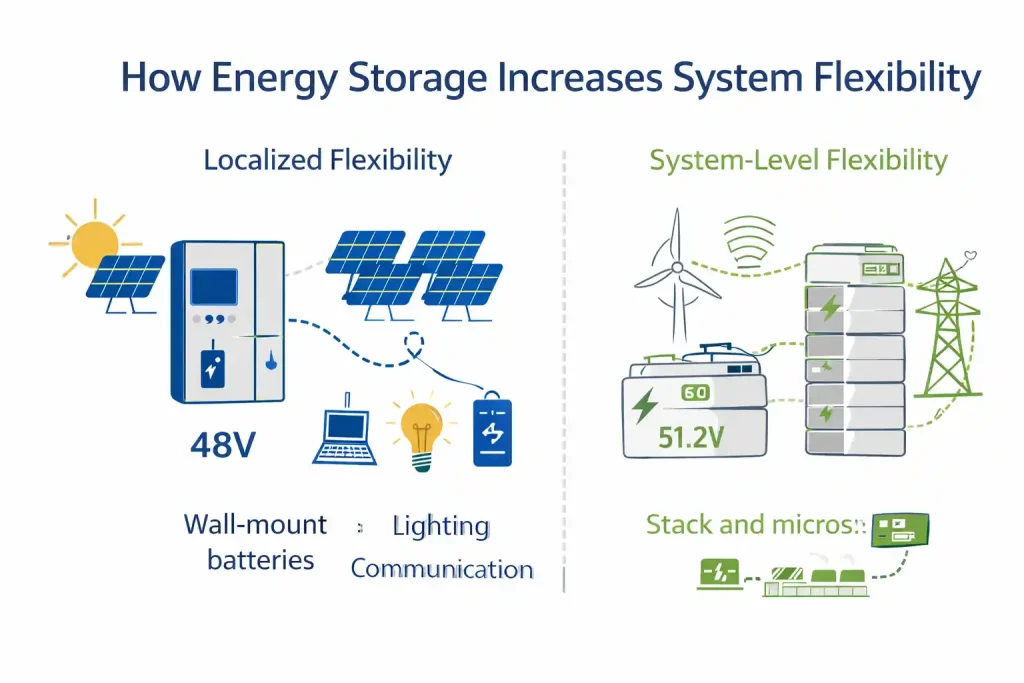
From a system perspective, Energy Storage increases flexibility, improves reliability, and strengthens security of supply. It allows power networks to absorb sudden surpluses of energy, manage peak demand more efficiently, and protect sensitive equipment from instability. At the same time, it enables greater integration of solar generation, reduces wasted energy, and supports the long-term shift toward cleaner and more electrified economies.
These are the key facts that make Energy Storage one of the most strategic technologies in today’s power industry — not only for large utility grids, but also for distributed solar systems, hybrid power setups, and localized energy networks that require consistent and dependable electricity.
Why Is System Flexibility a Key Fact in Energy Storage?
System flexibility is one of the most important reasons why Energy Storage has become essential in modern power systems. Flexibility refers to the ability of an electrical system to continuously balance supply and demand, even when both are changing rapidly. As renewable energy grows, this balancing task becomes far more complex.

Growing dependence on variable energy sources
Solar and other renewable power sources do not produce electricity in a steady, controllable way. Output rises and falls depending on sunlight, weather, and time of day. However, electricity demand follows its own patterns, driven by equipment operation, lighting, cooling, and industrial processes. This natural mismatch creates frequent periods of surplus and shortage within the same system.
Energy Storage solves this by acting as a buffer. When solar production exceeds demand, the excess energy is stored instead of being wasted. When demand rises or generation drops, the stored energy is released, keeping power flow smooth and predictable.
Managing energy across different time scales
Flexibility is not only needed in seconds or minutes. Power systems must also balance energy over hours, days, and even longer periods. Short-term storage stabilizes voltage and frequency, while larger battery systems shift energy between daytime production and nighttime consumption.
Wall-mounted battery units are often used to provide fast-response flexibility close to the load, supporting control equipment, lighting, and communication systems. Higher-capacity stacked battery systems, on the other hand, handle longer-duration energy shifting in solar and hybrid installations, allowing energy generated during the day to power systems well into the evening or overnight.
Preventing instability in high-renewable systems
As the share of renewable generation increases, traditional grid balancing methods become less effective. Without enough flexibility, power systems experience congestion, voltage instability, and curtailment of renewable energy. Energy Storage absorbs these fluctuations and releases power in a controlled way, preventing stress on the grid and maintaining reliable operation.
In real applications, this means solar-based systems can deliver consistent power instead of fluctuating output. It also means energy networks can support higher renewable penetration without sacrificing performance or safety.
How Is the Energy Storage Market Expanding Across Real Applications?
The rapid increase in system flexibility requirements has directly driven the expansion of the Energy Storage market. What was once limited to large-scale pumped hydro or centralized grid projects is now spreading across a wide range of real-world power applications.
From centralized storage to distributed systems
Energy Storage is no longer installed only at utility substations or power plants. Today, battery-based storage is increasingly deployed close to where energy is generated and consumed. Solar systems, hybrid power setups, and local electrical networks now integrate batteries as standard components rather than optional add-ons.
This shift allows power systems to respond more quickly to local demand changes, reduce stress on transmission networks, and improve overall efficiency. Wall-mounted battery systems provide localized energy buffering, while larger stacked battery platforms deliver higher-capacity energy shifting for more demanding installations.

Growth of LiFePO4-based battery storage
One of the main drivers behind this market expansion is the maturity of lithium iron phosphate (LiFePO4) battery technology. Compared to earlier battery types, LiFePO4 offers long cycle life, stable performance, and high safety, making it well suited for stationary Energy Storage.
Modern systems range from compact 48V batteries for small energy needs to high-voltage, high-capacity 51.2V battery stacks with hundreds of amp-hours of storage. This wide range allows Energy Storage to be matched precisely to application size without overdesign.
Scalable capacity for evolving energy demand
Energy demand rarely remains fixed. As more equipment, loads, or renewable capacity is added, storage must grow with the system. Stackable battery designs make this possible. Additional battery layers can be added to increase capacity without changing the entire power architecture.
This modular approach allows energy systems to start small and expand over time, supporting everything from basic solar buffering to large hybrid power platforms that operate across long time spans.
Why Do Global Energy Goals Depend on Energy Storage?
Around the world, energy systems are undergoing a fundamental transformation. Governments, utilities, and system designers are moving away from fossil-based generation toward renewable, electrified, and decentralized power architectures. This shift is driven by the need to reduce emissions, improve energy security, and build more resilient infrastructure.
However, renewable energy on its own is not enough to achieve these goals. Solar and wind power can only become the backbone of future energy systems if their variability can be managed. This is where Energy Storage becomes indispensable.
Enabling large-scale renewable integration
Global energy strategies increasingly depend on high levels of renewable generation. Without Energy Storage, much of this energy would be wasted when production exceeds demand or become unreliable when output drops. Storage allows renewable power to be captured, preserved, and delivered when it is most needed, turning intermittent generation into dependable energy.
Supporting energy independence and stability
Stored energy reduces dependence on external supply sources and fuel-based generation. It allows local power systems to rely more on their own renewable resources, improving resilience against supply disruptions and price volatility.
Powering the next stage of electrification
As transportation, industry, and infrastructure become more electric, demand for stable and flexible electricity grows. Energy Storage ensures that this growing demand can be met without compromising reliability, making electrification scalable and sustainable.
These global energy objectives — cleaner power, stronger grids, and secure supply — all converge on one key fact: without Energy Storage, the transition to a renewable-based energy system cannot succeed.
How Do Modern Battery Systems Turn These Key Facts into Real Power Solutions?
All the key facts about Energy Storage — system flexibility, market expansion, and global energy goals — ultimately need to be translated into reliable, practical power systems. This is where modern battery-based Energy Storage platforms play a decisive role.
Compact wall-mounted storage for localized flexibility
In many applications, energy demand is concentrated in specific parts of a power system, such as control panels, communication equipment, lighting circuits, and DC-powered devices. Wall-mounted 48V LiFePO4 battery systems provide an efficient way to store solar energy and deliver stable DC power exactly where it is needed.
These systems charge directly from solar panels or hybrid inverters and supply energy whenever generation drops. Their compact design makes them easy to integrate into electrical cabinets or small energy rooms while still offering long cycle life and stable voltage.
High-capacity stackable systems for extended energy shifting
When energy demand increases or longer operating time is required, stacked battery platforms provide the next level of Energy Storage. Multi-layer 51.2V LiFePO4 battery systems deliver large amounts of usable energy, allowing solar and hybrid installations to support loads well beyond daylight hours.
This type of storage is particularly effective for applications that require continuous power, peak-shaving, or long-duration backup. Because the batteries are modular, capacity can be expanded simply by adding more layers, without redesigning the rest of the power system.
Long-term performance and reliability
Modern LiFePO4 batteries are designed for thousands of charge and discharge cycles, often around 6,000 cycles under normal operating conditions. This makes them well suited for daily energy shifting in renewable-based systems, ensuring consistent performance over many years of use.
Their stable chemistry, high efficiency, and predictable voltage behavior also contribute to system safety and long-term operational stability.
Conclusion
The key facts about Energy Storage clearly show why it has become one of the most critical technologies in modern power systems. As renewable energy grows, flexibility, stability, and intelligent energy shifting are no longer optional — they are essential.
By enabling surplus energy to be stored and delivered when it is needed, Energy Storage supports reliable power supply, efficient renewable integration, and the global transition toward cleaner and more resilient energy systems.
Through wall-mounted and stackable LiFePO4 battery platforms, CARSPA provides Energy Storage solutions designed to transform these system-level requirements into practical, scalable, and dependable power applications.



.jpg)


.jpg)
.jpg)
.jpg)
.jpg)
.jpg)


