
How to choose the right inverter for your home?
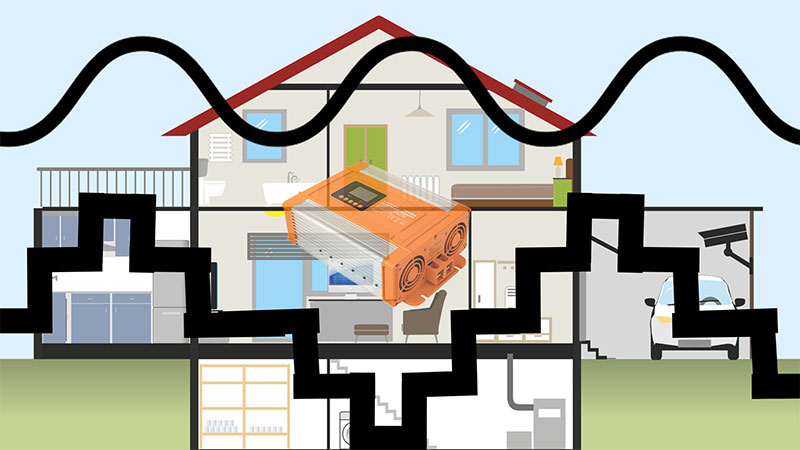
Power inverter is a device that converts DC power such as 12VDC/24VDC/48VDC and higher DC voltage to 110VAC/127VAC/220VAC/380VAC, and is used in households, vehicles, ships, industrial power stations, aviation platforms, etc.
When choosing an inverter, you can consider the following aspects:
1.Power requirements
Determine the total power the home requires from the inverter. Simple example: Suppose the devices in your home that require power from an inverter are: refrigerator, TV and washing machine. Assume that the appliances are rated as follows: refrigerator: 200W, TV: 100W, washing machine: 500W.
Then the power requirement of the inverter needed at home is: 200W + 100W + 500W = 800W
In actual use, factors such as the starting current of the device also need to be considered. It is best to set the full load power of the inverter at about 80% of its rated power capacity, which means you need a 1000W inverter.
2. Select according to application scenarios
There are two types of home inverters: modified sine wave inverters and home pure sine wave inverters.
A modified sine wave inverter is an affordable solution for converting DC power into a "modified" sine wave AC power. Due to its low cost and unstable output voltage and frequency, it is usually used in situations that do not require high electrical equipment, such as lamps, small appliances, etc. And it is not suitable for equipment with higher power quality requirements.
Household pure sine wave inverter can convert direct current into stable pure sine wave alternating current, which is the same as ordinary household electricity and is suitable for more types of electrical equipment, such as televisions, air conditioners, stereos, etc. Since its output electrical waveform is very close to the waveform of the mains power grid supply voltage, its conversion efficiency is very high and the loss of electrical equipment is relatively small.
3. Select an inverter according to the specific conditions of the country and region
- Comply with local standards and regulations: Different countries and regions may have different standards and regulations that require the functions and performance of the inverter. Make sure the selected inverter meets local technical standards and regulatory requirements to ensure safety and compliance.
- Grid type: Understand the local grid type (such as single-phase, three-phase, etc.) and its characteristics, and choose an inverter suitable for this grid type. Ensure that the inverter can be seamlessly connected to the local power grid and provide stable output.
- Voltage and frequency matching: Grid voltage and frequency may vary in different countries and regions. When selecting an inverter, ensure that its input and output voltages match the voltage requirements of the local grid and can adapt to the local grid frequency.
- Reliability and adaptability: Consider local climate conditions, environmental factors and work requirements, and select an inverter with good durability, reliability and adaptability. For example, if the climate conditions in your area are harsh, you need to choose an inverter that is dustproof, waterproof, and earthquake-resistant.
Before choosing an inverter, it is recommended to consult a professional energy consultant or technician to make a more accurate choice based on your family's specific situation and needs.


